.png?width=517&height=128&name=Group%20(2).png "Group (2)")
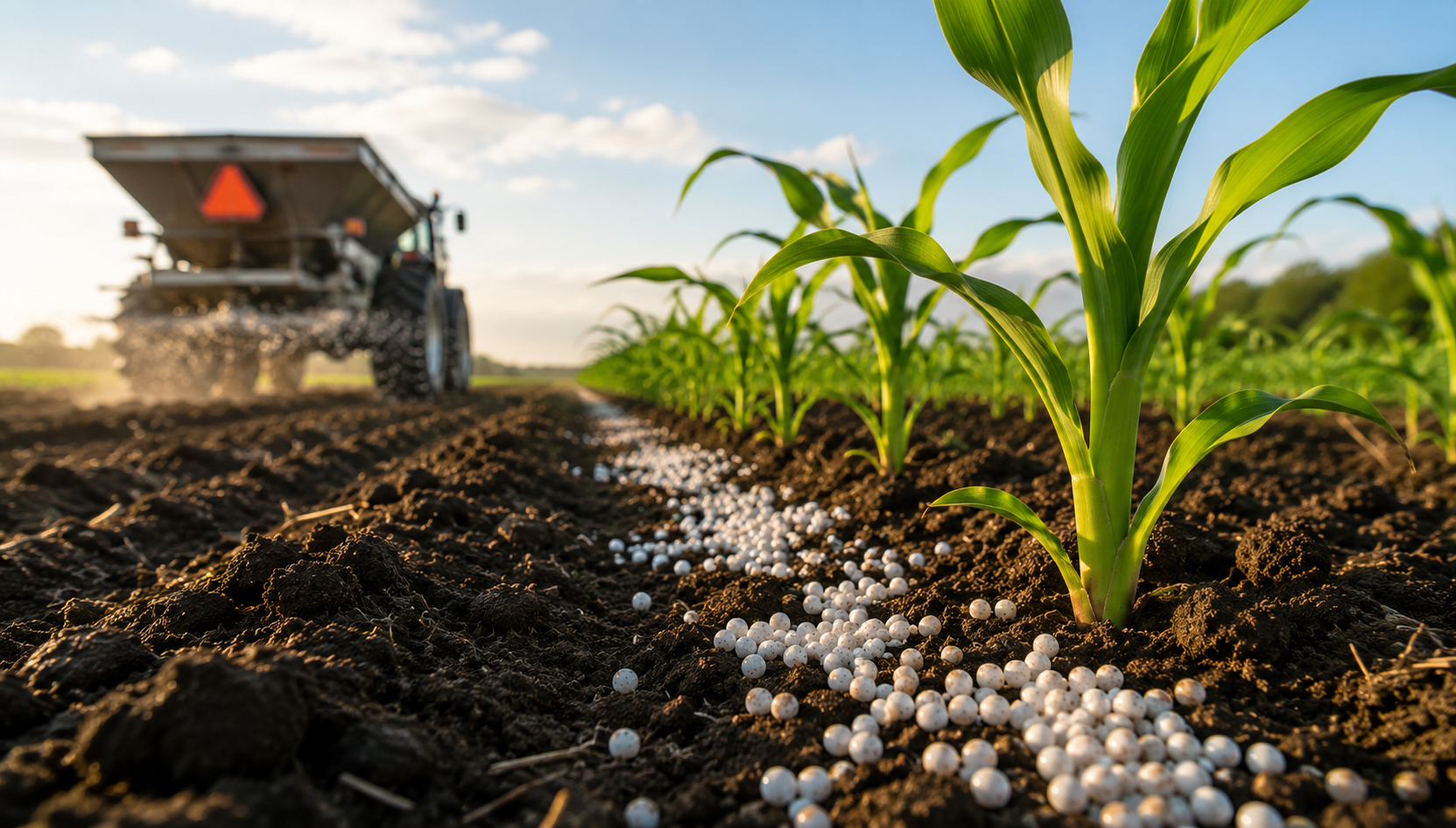
Food production requires nitrogen fertilizers. However, the production and use of synthetic nitrogen fertilizers and manure account for 5% of global greenhouse gas emissions. By 2050, the global population is expected to grow by 20%, further increasing the demand for food production. Today, less than 50% of nitrogen applied to fields is utilized by crops. Nitrogen is lost by leaching of ammonium (NH4+) and nitrate (NO3-), as well as volatilisation of ammonia (NH3).
To improve the physical quality of nitrogen fertilizers, coating technologies have been developed. However, today coating treatments are mostly considered a necessary cost to improve handling, reduce dust, or prevent caking. However, their potential extends beyond these physical functions. Why limit coatings to purely physical functions?
By viewing coatings as functional carriers, it becomes possible to integrate additional value by combining physical performance with biostimulant effects. This approach creates opportunities to improve nutrient use efficiency.
One example is the use of lignosulfonates as biostimulants in fertilizer coatings.
From binder to biostimulants
Lignosulfonates have a long history of use in agriculture as functional additives, particularly for their hardness, anti-caking and anti-dusting properties. These properties improve storage stability and handling. Fertilizer granules are typically coated, while lignosulfonates can either be applied as a coating or incorporated directly into the molten fertilizer stream during prill production.
Although all lignosulfonates exhibit modest biostimulant effects, Borregaard has developed specialized lignosulfonates with agronomic performance comparable to leading commercial biostimulants on the market. As biostimulants, lignosulfonates are associated with improved nutrient availability, enhanced root development, and increased resilience to abiotic stresses such as drought or salinity.
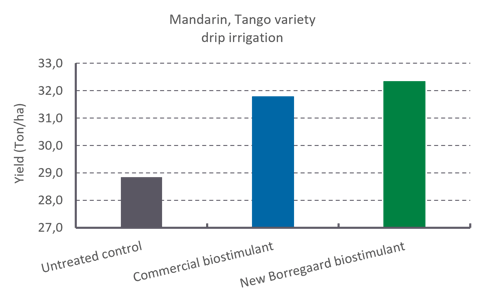 Figure 1 Open-field trial in mandarin grown in nutrient- deficient soil. Borregaard's new lignosulfonate biostimulant performs comparably to a commercial humic acid biostimulant
The combination of physical functionality and biological effects makes lignosulfonates particularly attractive for integration into fertilizer systems.
Turning fertilizer granules into delivery platforms
Fertilizer coatings offer a practical way to deliver biostimulant effects. Lignosulfonates can be incorporated into coating systems in several ways, including solvent- or water-based coating solutions, powder-based applications with a primer, or in combination with other additives such as anti-caking agents and micronutrients. In addition, lignosulfonates can be incorporated directly into fertilizer granules or prills during manufacturing, whether through molten streams, slurries or granulation processes. This flexibility enables fertilizer producers to integrate lignosulfonates into existing production processes with minimal modification.
This approach is not limited to a specific fertilizer. Lignosulfonates can be applied to all types of fertilizers, supporting both commodities and more specialized products.
Depending on the formulation and application method, lignosulfonates can be used across a broad dosage range. Typical inclusion levels are in the range of 0.1–1.0% w/w, allowing producers to tailor performance and achieve the desired balance between coating functionality and biostimulant effect.
What do we see in application testing?
Application testing indicates that lignosulfonate-based coatings can influence both the physical properties of fertilizers and their nitrogen-use performance.
Granular urea typically provides better absorption of the coating due to its higher porosity, resulting in more controlled dissolution and a lower tendency to cake.
In addition, laboratory testing shows that lignosulfonate-based coatings can reduce ammonia (NH₃) volatilisation compared to untreated fertilizer. Under certain conditions, reductions in the range of 20–40% have been observed for granular urea, with lower but still measurable effects for prilled materials.
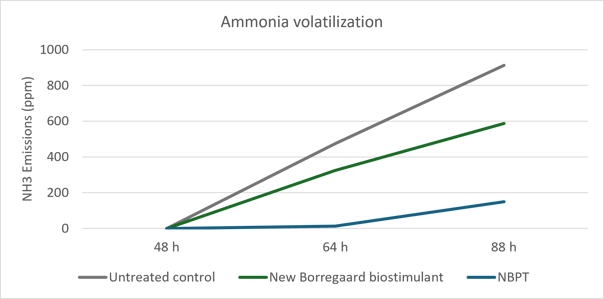 Figure 2 Internal research on ammonia volatilisation of coated urea granules. The new lignosulfonate shows clear reduction, although weaker than urease inhibitors, such as NBPT.
While these effects are not intended to fully replace dedicated urease inhibitors such as NBPT, which reduce ammonia volatilisation by inhibiting urease activity, they demonstrate that coating strategies can contribute to improved nitrogen-use efficiency through different modes of action. Combined with the biostimulant effects at plant level, this creates opportunities to enhance overall fertilizer performance.
Evidence from coated urea studies
Evidence from peer-reviewed field and greenhouse studies supports the concept of fertilizer coatings as functional delivery systems. Research conducted at Valencia Polytechnic University demonstrated that urea coated with lignosulfonate-based polymers and humic substances improved both nitrogen-use efficiency and crop performance across different crops.
In rice, controlled-release fertilizers based on lignosulfonate coatings showed 35% higher yields under controlled conditions, while also improving nutrient uptake. At field scale, comparable yields were maintained even when nitrogen application rates were reduced by 20%.
In wheat, comparable results were observed. Coated fertilizers enabled a reduction in nitrogen input while maintaining crop yields and significantly increasing nitrogen-use efficiency by up to 30–40% depending on treatment conditions.
P use efficiency
Lignosulfonates not only support more efficient utilisation of nitrogen, but can also improve phosphorus availability and uptake.
Internal research on Borregaard's new lignosulfonate biostimulant has demonstrated enhanced phosphate solubilisation, with performance exceeding that of humic acids under the tested conditions. These results suggest that new lignosulfonate biostimulants help make soil phosphorus more available to plants.
Additional soil incubation studies conducted by external research partners showed that a range of lignosulfonates increased the amount of plant-available phosphorus in soil. These findings indicate that the effect is not limited to a single product, but may represent a broader property of lignosulfonate-based technologies.
Research at Mohammed VI Polytechnic University (UM6P) further demonstrates how lignin-based coating technologies can contribute to phosphorus-use efficiency. In this study, triple superphosphate (TSP) fertilizer granules were coated with lignin, resulting in slower release of phosphorus, higher levels of plant-available phosphorus in soil, and increased biomass compared with uncoated fertilizer. The authors concluded that controlled phosphorus release helped maintain nutrient availability over a longer period, improving the plant's ability to utilise applied phosphorus.
Together, these results highlight the potential of lignin-based technologies to improve phosphorus-use efficiency through both enhanced phosphorus availability and optimised nutrient delivery.
Multifunctional fertilizers
Lignosulfonate-based fertilizer coatings can be designed as multifunctional systems, combining physical benefits such as dust reduction, anti-caking performance and improved granule handling with agronomic benefits such as improved nitrogen-use efficiency, improved phosphorus availability and biostimulant activity. This creates opportunities to upgrade both commodity and specialty fertilizers without moving away from existing fertilizer granules.
Improving nutrient use efficiency is the single most important parameter influencing the global GHG emissions of synthetic fertilizers. As the industry continues to move towards more sustainable and efficient solutions, coating-based delivery of biostimulants such as lignosulfonates is expected to play an increasingly important role.
References
Ligno Tech USA patent: Lignosulfonates as conditioning agents in fertilizer coatings
Valencia Polytechnic University: Coated urea in wheat
Valencia Polytechnic University: Coated urea in rice
Nature Food: Greenhouse gas emissions from synthetic fertilizers
Mohammed VI Polytechnic University (UM6P): Lignin-coated triple superphosphate for improved phosphorus efficiency