.png?width=517&height=128&name=Group%20(2).png "Group (2)")
How to Reduce Excessive Nutrient Leaching in Shrimp Feed
Nutrient leaching is one of the most overlooked challenges in shrimp feed production. Once submerged, shrimp feed pellets begin interacting with water immediately, and if valuable nutrients are lost too quickly, feed efficiency, pond conditions and shrimp performance may suffer.
Unlike many fish species, shrimp are relatively slow feeders (nibblers) and rely heavily on scent and taste signals in the water to locate feed. Pellets may remain submerged for extended periods before being consumed, increasing the importance of maintaining pellet integrity and nutrient retention.
For feed formulators and nutritionists, the challenge is not to eliminate nutrient release altogether. Some release of feeding attractants is desirable to stimulate feeding behaviour. The goal is instead to reduce excessive nutrient leaching while maintaining sufficient feed attractiveness and digestibility.
In this article, we explore what nutrient leaching is, why it matters, and practical ways to improve nutrient retention in shrimp feed.
Table of contents
- 1. What Is Nutrient Leaching?
- 2. The Balance Between Feed Attraction and Nutrient Retention
- 3. Why Shrimp Feed Is Particularly Vulnerable
- 4. Why Excessive Nutrient Leaching Matters
- 5. What Causes Excessive Nutrient Leaching?
- 6. Six Ways to Reduce Excessive Nutrient Leaching
- 7. A Sustainable Approach to Pellet Water Stability
- 8. Can Better Water Stability Help Reduce Nutrient Leaching?
- 9. Conclusion
1. What Is Nutrient Leaching?
Nutrient leaching refers to the loss of water-soluble nutrients from feed pellets after immersion.
Once pellets enter the water, certain compounds may start to dissolve or diffuse from the pellet surface. Depending on pellet quality, feed formulation and immersion time, this can result in the loss of:
- Water-soluble vitamins
- Free amino acids and feeding attractants
- Minerals
- Small peptides and soluble proteins
- Functional feed ingredients
Excessive leaching means shrimp may consume pellets that no longer contain the intended nutritional value. However, some leaching of feeding attractants is desirable to help stimulate feeding behaviour.
2. The Balance Between Feed Attraction and Nutrient Retention
Shrimp rely heavily on sensory signals to locate feed. For this reason, some release of feeding stimulants into the water is beneficial.
Ingredients such as free amino acids, betaine, krill hydrolysates and fish solubles help create a chemical signal that attracts shrimp and stimulates feeding behaviour.
The challenge for nutritionists is therefore to strike the right balance:
Allow sufficient release of feeding cues while retaining nutritional value until the feed is consumed.
Pellets that disintegrate too quickly may lose valuable nutrients before shrimp consume them. On the other hand, pellets that are overly resistant may reduce feed attractiveness or digestibility.
3. Why Shrimp Feed Is Particularly Vulnerable
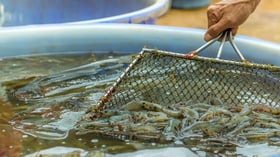
Compared with many other aquafeeds, shrimp feed often requires higher water stability.
Feeding behaviour
Shrimp are bottom feeders and typically eat more slowly than many fish species. Feed may remain submerged for extended periods before being consumed.
Farming conditions
In pond systems, pellets are exposed to water movement, microbial activity and prolonged immersion, increasing the risk of nutrient loss.
Feed economics
Feed costs account for a substantial proportion of shrimp production costs. Excessive nutrient loss may reduce feed conversion efficiency and increase production costs.
For these reasons, pellet durability and water stability are particularly important in shrimp feed production. Industry guidance highlights that shrimp feed typically requires higher water stability than many fish feeds due to longer immersion times and bottom-feeding behaviour (Global Seafood Alliance, Measuring shrimp feed water stability).
4. Why Excessive Nutrient Leaching Matters
Reduced Feed Efficiency
When nutrients leach into the water before consumption, shrimp may receive less nutritional value than intended.
This can contribute to:
- Reduced growth performance
- Poorer feed conversion ratio (FCR)
- Increased feed costs
Poor Pond Water Quality
Leached nutrients contribute to increased organic matter and nutrient loading in ponds.
Consequences may include:
- Higher ammonia levels
- Oxygen depletion
- Increased animal stress
- Greater disease risk
- Higher mortality or need for treatment
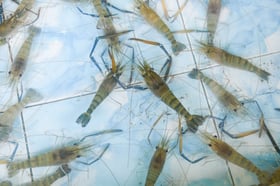
Environmental Impact
Nutrient loss also reduces feed efficiency and contributes to increased environmental emissions, an increasingly important consideration for sustainability standards and export markets.
5. What Causes Excessive Nutrient Leaching?
Several factors influence how well nutrients are retained after immersion.
1. Pellet Water Stability
Water stability is one of the most important factors influencing nutrient retention.
Pellets with stronger physical integrity generally expose less surface area to water and are less likely to lose nutrients prematurely.
However, good pellet stability alone does not guarantee nutrient retention, as some water-soluble compounds may still diffuse through the pellet matrix.
2. Raw Material Composition
Most feed ingredients influence pellet quality and water stability.
Changes in raw materials, ingredient quality or inclusion of new protein sources may affect pellet integrity and nutrient retention.
This makes formulation flexibility and process consistency increasingly important.
3. Processing Conditions
Production parameters play a key role in pellet quality.
Factors such as:
- Conditioning
- Moisture control
- Starch gelatinisation
- Die performance
- Operator training
all influence pellet durability and water stability.
4. Pellet Fines and Dust
Weak pellets and excessive fines increase surface area exposed to water, accelerating nutrient loss.
Reducing fines and dust can also improve feed mill performance through lower rework rates, improved throughput, reduced housekeeping requirements, lower manufacturing costs, and more consistent finished feed quality.
6. Six Ways to Reduce Excessive Nutrient Leaching
Improve Pellet Water Stability
Maintaining pellet integrity during immersion is one of the most effective ways to support nutrient retention.
Optimise Feed Formulation
Balancing ingredient selection and understanding raw material interactions can improve pellet quality and reduce nutrient losses.
Improve Process Control
Consistent conditioning, moisture management and operator training help maintain stable pellet quality over time.
Reduce Pellet Fines
Improving pellet durability and reducing dust generation can help minimise nutrient exposure to water.
Consider Pellet Binder Selection
An effective pellet binder can help maintain pellet integrity across varying formulations and production conditions.
A good binder should:
- Support consistent water stability
- Reduce fines generation
- Allow formulation flexibility
- Be safe and easy to handle
- Avoid negatively affecting process performance
New, sustainable pellet binders are increasingly helping feed producers improve pellet durability and maintain a consistent water stability while reducing reliance on traditional urea-formaldehyde-based solutions.
Regulatory scrutiny of formaldehyde-based feed additives has also increased in some markets, including the EU, where formaldehyde feed additive authorisations have been withdrawn (Commission Implementing Regulation (EU) 2018/183).
Optimise Feeding Practices
What happens on the farm also matters. The longer pellets remain uneaten in the water, the greater the opportunity for nutrients to leach from the feed.
Feeding strategies that better match feed delivery to shrimp consumption can help reduce unnecessary immersion time and feed waste. More frequent feeding in appropriate portions may therefore complement improvements made through formulation, processing and pellet quality.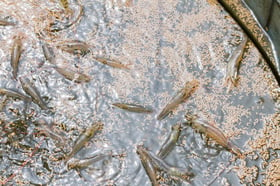
7. A Sustainable Approach to Pellet Water Stability
Improving pellet water stability is one of the most effective ways to support nutrient retention in shrimp feed. Sustainable pellet binders are increasingly helping feed producers maintain pellet integrity across varying formulations and processing conditions.
Intact Aqua is Borregaard’s sustainable pellet binder for shrimp and aquafeed production, developed to support consistent water stability and process performance without relying on urea-formaldehyde-based solutions.
Learn more about Intact Aqua and its role in shrimp feed production.
8. Can Better Water Stability Help Reduce Nutrient Leaching?
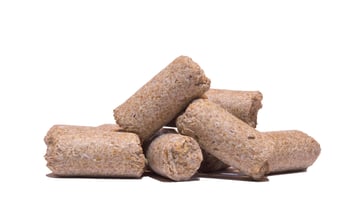
Although nutrient retention depends on multiple factors, improved water stability is generally associated with reduced nutrient loss.
By helping pellets retain their structure during immersion, effective binders may contribute to better nutrient retention, particularly in feeds exposed to prolonged immersion times.
For shrimp feed producers, maintaining the right balance between feed attraction, nutrient retention and digestibility remains key.
9. Conclusion
Reducing excessive nutrient leaching in shrimp feed requires a combination of good formulation, process control, pellet quality and binder selection. What happens after the feed leaves the mill also matters: appropriate feeding routines can reduce the time pellets remain uneaten in the water and help minimise unnecessary nutrient loss.
For nutritionists and feed producers, the goal is not to eliminate nutrient release entirely, but to achieve the right balance between feed attractiveness, water stability and nutrient retention. A well-considered approach, from formulation and production through to feeding at the farm, can help improve feed efficiency, pond conditions and consistency over time.
To learn more about water stability in aquafeed production, read our article: Your Guide to Shrimp and Aquafeed Water Stability.