.png?width=517&height=128&name=Group%20(2).png "Group (2)")
PLANT NUTRITION
IMPROVING PERFORMANCE AND ROBUSTNESS IN SUSPENSION FORMULATIONS
Suspension concentrates (SCs) used in plant nutrition must remain stable, homogeneous, and easy to apply throughout storage, handling, and tank mixing – all while formulators strive to maximise active ingredient loading in increasingly complex formulations. Poor dispersion and tank-mix compatibility issues can lead to gelling, sedimentation, active ingredient degradation, clogged nozzles, and uneven application, compromising both product performance and ease of use.
At the same time, increasing sustainability and regulatory requirements are driving demand for safe, bio-based and microplastic-free technologies without compromising formulation stability or application performance.
Our products
How our solutions address formulation challenges
Borregaard’s lignin-based technologies help improve dispersion, suspension stability and compatibility in complex plant nutrition formulations. Our bio-based dispersants, binders and rheology modifiers enable stable high-loaded formulations, robust tank-mix performance, extended shelf life and reliable application across a wide range of chemical environments.
Improving Dispersion & Active Loading
Our products enable high-loaded formulations with improved dispersion and flowability.
Enhancing Stability & Compatibility
Improve stability in electrolyte systems, hard water, fertilizer tank mixes and microbials formulations.
Supporting sustainable formulations
Develop high-performance formulations with bio-based and microplastic-free ingredients.
Trial data
Improve Dispersion & Active Loading
Borregaard's dispersants and rheology modifiers can stabilize high-load suspension concentrates with improved viscosity and application performance across a wide range of formulation types and chemical environments.
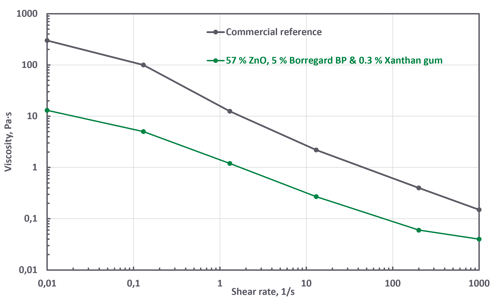
A formulation with Borregaard's dispersant was developed to match a commercial reference sample containing 57% dry matter content of zinc oxide and shear viscosity was measured. Results show better flow properties of the suspension with our products and no sediment after 2 weeks.
Key benefits
-
Enables increased active ingredient loading while maintaining flowability
-
Reduced sedimentation and phase separation
-
Effective across a wide range of substrates and formulation types
-
Robust performance during storage and handling

WHAT THE PERFORMANCE DATA SHOWS
Want to understand the science behind electrolyte-tolerant SC formulations?
Join our webinar and discover how lignin biopolymers and microfibrillated cellulose improve suspension concentrates as dispersants and rheology modifiers. Gain insights into functionality, formulation strategies, and how to address challenges like stability and compatibility − while exploring more sustainable solutions aligned with EU regulations.
Watch our on-demand webinar with Borregaard's formulation specialists.
Trial data
Enhancing stability & compatibility
Maintaining compatibility across different formulation components and tank-mix conditions is essential for reliable product performance. Borregaard's formulation technologies help maintain stable suspensions in challenging chemical environments, including electrolyte-rich systems, hard water, liquid fertilizers, and formulations containing biological or microbial ingredients.
Key benefits
-
Compatible with complex and multi-component formulations.
-
Compatible with microbes.
-
Improved hard-water and tank-mix compatibility.
-
Reduced nozzle clogging and sedimentation.
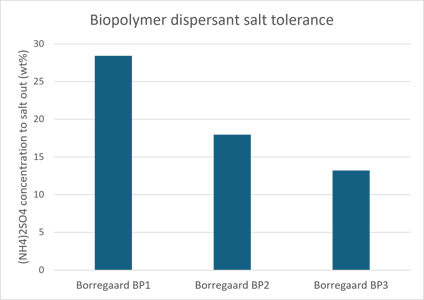
Our dispersants products maintained suspension stability under high electrolyte concentrations, demonstrating excellent compatibility with fertilizer-rich formulations.
Sustainability
Supporting robust & sustainable formulations
Our bio-based lignosulfonate additives help formulators develop high-performance agricultural formulations with a strong regulatory and sustainability profile. Produced from renewable wood-based materials, they offer a lower carbon footprint than many synthetic alternatives1, are microplastic-free, and can support the development of more sustainable agricultural products.
Lignosulfonates are widely accepted as inert ingredients, adjuvants, and micronutrient complexing agents in agricultural applications, including organic-certified farming. Selected products are also OMRI Listed2, helping support formulation compliance across global markets without the need for regional reformulation.
Key benefits
Low risk of regulatory-driven reformulation and favorable sustainability profile due to:
-
Non-hazardous and non-toxic
-
Non-GMO and solvent-free
-
Microplastic-free
-
Inherently biodegradable3
-
REACH exempt (polymer)
¹ Lower carbon footprint: Soldal and Modahl (2019): Environmental analysis of competing products for lignin from Borregaard, OR 39.19, Fredrikstad: Ostfold Research (now NORSUS).
² OMRI Listed: Some of Borregaard's products are OMRI Listed.
³ Biodegradable: Biodegradable means that lignosulfonates degrade in the environment along similar pathways to lignin in woody biomass.
From nature to know-how
IMPROVED STABILITY AND TANK-MIX COMPATIBILITY
Maintaining suspension stability and reliable tank-mix compatibility is critical for consistent formulation and spray performance. Dispersant interactions within the formulation and the spray solution play a key role in wetting, granule break-up, particle dispersion and overall suspension stability.
Sustainable agriculture
Agriculture is increasingly exposed to extreme and unpredictable conditions, including heatwaves, drought, heavy rainfall and rapid temperature shifts. These challenges place higher demands on agricultural inputs and increase the importance of formulation performance. When products lack stability or fail to perform consistently under stress, the risk of yield loss and inefficiencies rises, affecting farmers, formulators and the wider ecosystem.
OMRI Listed products
Borregaard offer fertilizer additives, inerts and co-formulants certified for organic use in farming, ornamentals and landscaping soil conditioners.
Frequently asked questions
-
Why is electrolyte tolerance important in suspension concentrates?
Many plant nutrition formulations contain high concentrations of dissolved salts that can destabilize conventional dispersants. Electrolyte-tolerant technologies help maintain particle dispersion and suspension stability, even in fertilizer-rich formulations, improving compatibility during storage, tank mixing and application
-
Why is compatibility important in fertigation systems?
Poor compatibility can lead to sedimentation, precipitation and clogging of irrigation equipment, resulting in uneven nutrient delivery and reduced application efficiency. Formulation technologies that improve stability and compatibility help ensure reliable performance throughout the fertigation system.
-
Why do suspension concentrates become unstable over time?
Suspension instability can result from particle aggregation, sedimentation, electrolyte interactions or poor compatibility between formulation components. Selecting the appropriate dispersant and rheology modifier helps maintain homogeneous suspensions during storage, transport and application.
-
How do Borregaard’s bio-based dispersants compare to synthetic alternatives?
Borregaard's bio-based dispersants deliver excellent dispersion, stability and compatibility across a wide pH range and under high-electrolyte conditions. In addition to matching the performance of many synthetic alternatives, they are microplastic-free and based on renewable raw materials, supporting more sustainable agricultural formulations.
-
Can borregaard’s dispersants be used specifically for micronutrient suspension concentrates?
Yes. Borregaard's dispersants are well suited for micronutrient suspension concentrates and have demonstrated excellent performance in high-electrolyte systems. Technical resources, including formulation webinars and application data, are available to support formulators developing stable and robust suspension concentrates.