CROP PROTECTION CO-FORMULANTS
Improved stability and tank-mix compatibility
Maintaining suspension stability and reliable tank-mix compatibility is critical for consistent formulation and spray performance. Dispersant interactions within the formulation and the spray solution play a key role in wetting, granule break-up, particle dispersion and overall suspension stability.
Tank-mix conditions can differ significantly from standard dilution water, particularly in the presence of fertilisers, hard water or high electrolyte concentrations. These environments can compromise dispersion behaviour and suspension stability, leading to instability, sedimentation and reduced spray performance.
Our products
Dispersants for challenging tank-mix systems
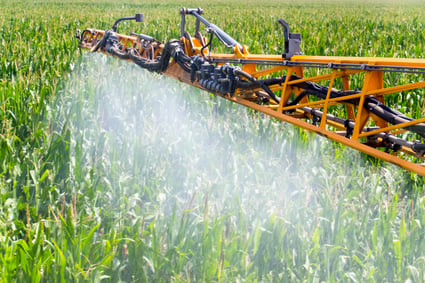
Our lignosulfonate-based dispersants have been developed to maintain dispersion performance under demanding tank-mix conditions, including fertiliser-containing systems, hard water and high-electrolyte environments.
Under elevated ionic strength conditions, conventional dispersants may lose efficiency, resulting in slower wetting, delayed granule disintegration, particle agglomeration and unstable suspensions.
Technologies with increased electrolyte tolerance and optimised anionic charge density help maintain the following:
-
Rapid granule wetting and break-up
-
Efficient particle dispersion
-
Electrostatic stabilisation
-
Suspension stability during dilution and spraying
These properties support improved robustness and compatibility across challenging WG and SC tank-mix systems.
Selected technologies within the Greensperse® range demonstrate strong dispersing efficiency and suspension stability even under electrolyte stress conditions.
Trial data
Greensperse S9 performance in WG formulations
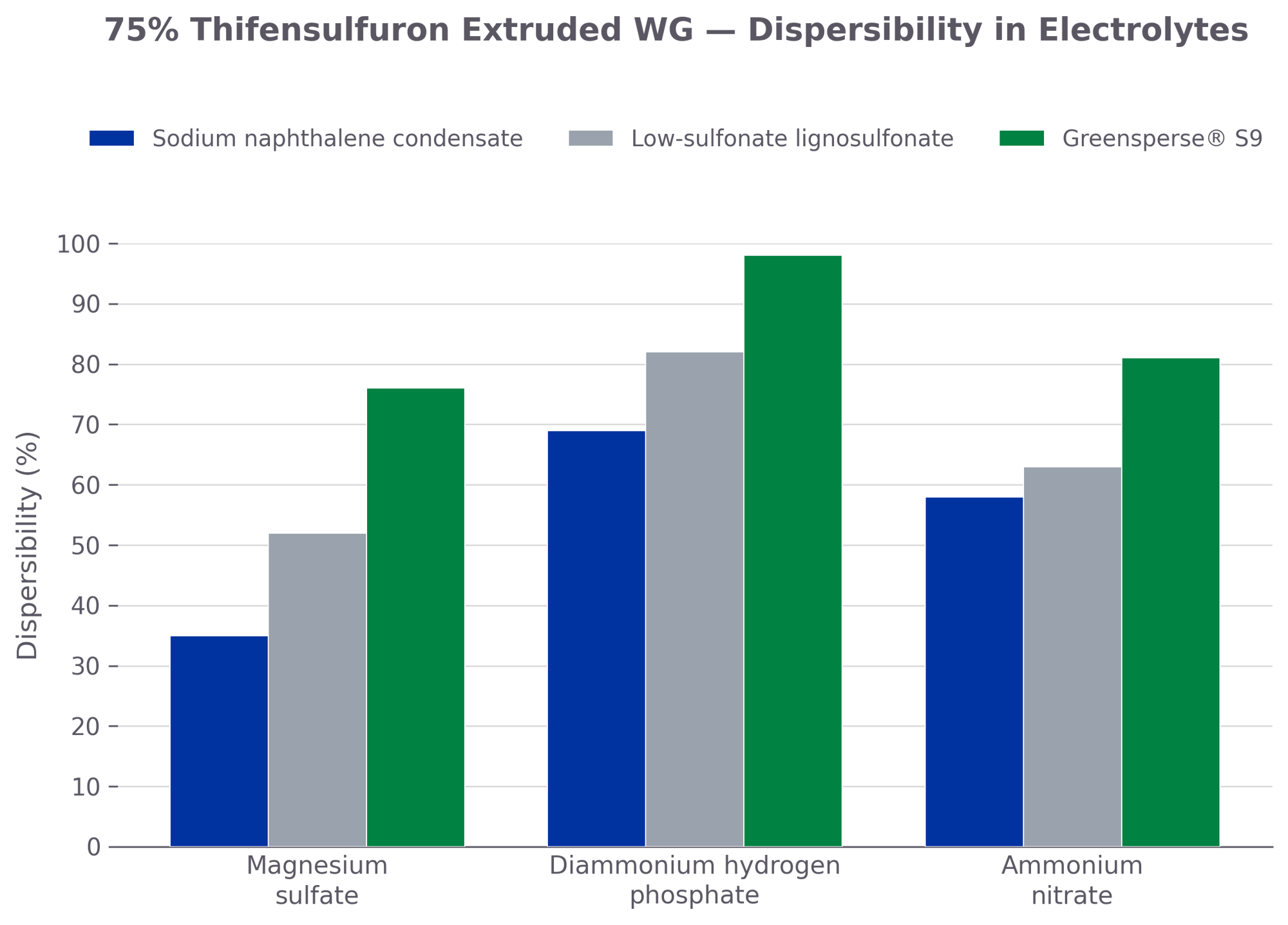
Our laboratory tests showcase the benefits of using Greensperse® S9 in water-dispersible granules (WG) under challenging electrolyte conditions. Results demonstrate strong tolerance to electrolyte-rich environments. Greensperse® S9 maintains dispersing performance even at elevated salt concentrations, making it well suited to formulations where fertiliser compatibility and tank-mix stability are critical.
Compared with standard lignosulfonate and sodium naphthalene dispersants, Greensperse S9 showed improved dispersibility in electrolyte-containing systems.
This performance helps support formulation robustness and more reliable tank-mix behaviour in fertiliser-containing spray solutions.

Key takeaways
-
Improved compatibility in fertiliser-containing spray systems
-
Better dispersibility in electrolytes than standard lignosulfonate and sodium naphthalene dispersants
-
Reliable granule disintegration in hard water and fertiliser solutions
Trial data
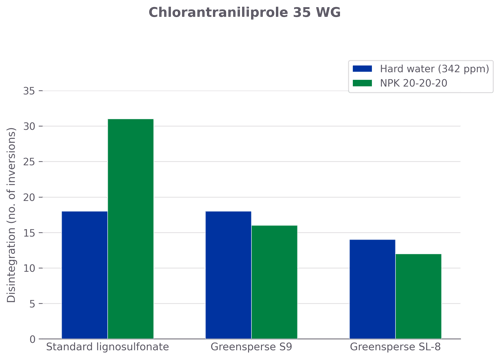
Product performance in granule disintegration
As illustrated in the graph, biopolymers with higher salt tolerance, such as the Greensperse range, contribute to more rapid granule disintegration than standard lignosulfonates, both in hard water and in fertiliser systems.

From nature to know-how
Trends toward more sustainable crop protection
Discover the trends shaping sustainable and organic crop protection, from biocontrol to greener co-formulants for WG, SC and CS formulations.
Sustainable agriculture
Sustainable agriculture starts with better formulations. Explore bio-based additives for higher yields, healthier soils, organic farming and lower emissions.
Frequently asked questions
-
Our WG formulation struggles to disperse in tank-mixes with fertilisers or hard water - what can help?
This is a classic electrolyte-stress challenge. Our Greensperse range of dispersants is designed for demanding tank-mix scenarios. They feature increased anionic charge-density for faster wetting and improved electrostatic stabilization, with options that maintain full dispersing efficiency even under high ionic strength, making them well suited to tank-mixes containing liquid fertilisers or hard water.
-
How can I request a sample?
You can contact our team through the contact form below.
-
What specific benefits do electrolyte-tolerant dispersants deliver vs standard options?
Three key benefits are faster granule disintegration in the tank, enhanced dispersion stability under electrolyte stress and improved compatibility in complex tank-mix environments, including mixes with liquid fertilisers or hard water that would destabilise standard dispersants. Performance data is available on the website.
.png?width=517&height=128&name=Group%20(2).png)