.png?width=517&height=128&name=Group%20(2).png "Group (2)")
Sustainable agriculture
How we contribute to Sustainable Agriculture
Agriculture is increasingly exposed to extreme and unpredictable conditions, including heatwaves, drought, heavy rainfall and rapid temperature shifts. These challenges place higher demands on agricultural inputs and increase the importance of formulation performance. When products lack stability or fail to perform consistently under stress, the risk of yield loss and inefficiencies rises, affecting farmers, formulators and the wider ecosystem.
At Borregaard, sustainable agriculture means building efficiency into every formulation. We develop robust, bio-based additives that help formulators improve performance, stability and input efficiency in real farming conditions. This supports lower emissions and reduced environmental impact without compromising productivity or farm profitability. Our bio‑based additives support productive agriculture through more efficient and responsible use of resources.
Our solutions enable formulators to:
- Improve formulation stability and compatibility
- Enhance the delivery and effectiveness of active ingredients
- Reduce resource use and minimize losses
- Lower environmental impact while maintaining performance
Higher yield, lower impact
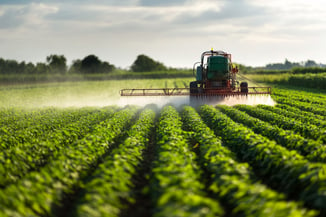 Agriculture faces a fundamental challenge: producing more food for a growing global population while reducing the environmental impact.
Borregaard's bio-based ingredients help formulators and growers achieve both simultaneously. By improving nutrient use efficiency, enhancing the delivery and effectiveness of active ingredients and reducing input losses, our products support higher yields without increasing the environmental burden on soils, water systems or the wider ecosystem.
In practice, this means:
- Crops that absorb more of the fertilizer applied and reduce runoff and waste.
- Formulations that perform more consistently under stress conditions protecting yield even in difficult seasons.
- Inputs with a lower carbon footprint than synthetic alternatives, contributing to the sustainability goals of the full agricultural value chain.
Regenerative agriculture and soil health
Regenerative agriculture aims to actively restore what conventional farming has depleted: soil organic matter, microbial diversity, water retention and long-term fertility. Healthy soils are not just more productive; they are more resilient to climate extremes and play a critical role in carbon sequestration.
Borregaard's bio-based solutions support this transition in practice. Our lignosulfonate-based soil conditioners and biostimulants improve the biological and chemical conditions in the soil by supplying organic carbon and reducing the physical and chemical stress that limits plant performance.
What does this mean in practice?
- Soil conditioners that supply organic carbon and soluble sulfur, supporting microbial activity and nutrient cycling.
- Biostimulants that improve root development, nitrogen uptake and nutrient use efficiency, reducing the need for repeated fertilizer applications.
- Salinity correction products that lower the sodium adsorption ratio (SAR) and improve water infiltration in salt-stressed soils.
- Products that are non-toxic, biodegradable and compatible with soil fauna and beneficial microorganisms.
- Borregaard's bio-based ingredients are non-toxic and support microorganisms for healthy ecosystems.
Organic Farming
Organic farming requires inputs that meet strict certification standards without compromising on agronomic performance. Borregaard offers a range of products that are approved for certified organic use across major markets, making them a natural fit for formulators and growers working within organic systems.
Our products are non-toxic, GMO-free and derived from sustainably managed wood, a raw material that does not compete with agricultural land or food production. They contain only elements beneficial to plant life and soil health: organic carbon, sulfur and carbohydrates.
Borregaard's ingredients can be used as co-formulants, inerts, adjuvants and rheology modifiers in crop protection formulations and as complexing agents in plant nutrition products. Borregaard has OMRI Listed products available.
Lower emissions
Switching to bio-based co-formulants is one of the most effective ways to reduce the environmental footprint of agricultural formulations - without compromising performance. Borregaard’s ingredients are derived from wood, a renewable raw material that naturally captures and stores CO₂ during forest growth, helping to lower the carbon impact across the entire product lifecycle.
Our solutions combine sustainability with proven functionality in demanding agricultural applications. Independent, third-party verified Life Cycle Assessments demonstrate that selected Borregaard products outperform fossil-based alternatives across key environmental indicators - from climate impact and resource efficiency to toxicity and ecosystem effects.
To support your sustainability goals, we offer independently verified Environmental Product Declarations (EPDs) for our lignosulfonates produced in globally. These provide transparent, credible data you can rely on in formulation development, procurement decisions, and sustainability reporting - helping you deliver crop protection solutions aligned with the expectations of regulators, growers, and the value chain.
How our products improve your formulation
Plant Nutrition Ingredients
Sustainable functional ingredients for plant nutrition.
Crop Protection adjuvants
Sustainable co-formulants, ingredients and adjuvants for crop protection.
Biological co-formulants
Safe co-formulants fully compatible with a wide range of biological actives.
Frequently asked questions
-
Does Borregaard have Environmental Product Declarations (EPDs)?
Yes. Borregaard has independently verified Environmental Product Declarations (EPDs) based on third-party Life Cycle Assessments (LCAs). EPDs are available for selected products, including liquid and powder lignosulfonates from our plants in Norway and the USA. For more information, visit Documented Low Footprints.
-
Do Borregaard products reduce carbon footprint compared to synthetics?
In many applications, yes. Third-party verified Life Cycle Assessments show that Borregaard products have lower climate footprints and better environmental performance than competing synthetic or oil-based alternatives. The results are documented through LCAs and, for selected products, Environmental Product Declarations (EPDs). Please read more here.
-
What regulatory status do Borregaard products have?
Borregaard products are exempt from registration under EU REACH requirements. Some products may also be eligible for use in EU fertilising products under CMC 1, and some are also OMRI Listed.
Regulatory status depends on the specific product, application and market. Please contact our team for product-specific regulatory information. -
Does Borregaard have any transition plan to reduce its emissions by 2030 and 2050?
Yes. Borregaard has science-based targets approved by the Science Based Targets initiative (SBTi). The company has committed to reducing Scope 1 and 2 greenhouse gas emissions by 42% by 2030 and Scope 3 emissions by 25%, both from a 2020 base year. Borregaard aims to achieve net-zero greenhouse gas emissions across the value chain by 2050, corresponding to a 90% absolute reduction.
Progress, targets and actions are reported through Borregaard's annual Sustainability Report. Read the Sustainability Report.