.png?width=517&height=128&name=Group%20(2).png "Group (2)")
Your guide to shrimp and aquafeed water stability
Water stability describes how well an aquafeed pellet retains its physical integrity and nutritional value once submerged. In shrimp and aquafeed production, this crucial feed quality parameter affects everything from feeding behaviour to pond health and export readiness.
In this section we explore the technological, formulation and process-based factors that determine success. Learn how to achieve consistent pellet water stability, what role binders play, and which species and systems demand the highest standards of durability.
Table of contents
- 1. Why Water Stability Matters
- 2. How to Achieve Good and Consistent Water Stability
- 3. What Makes a Binder Effective
- 4. Which Aquafeeds Require High Water Stability - and Why
- 5. Challenges with Current Binding Agents
- 6. Regulatory Aspects
- 7. Impact of Raw Materials
- 8. Pelleting vs. Extrusion: Effects on Water Stability
- 9. Why Is Intact Aqua Different?
- 10. Conclusion
1. Why Water Stability Matters
Pellet water stability is a critical quality parameter in aquafeed production. It determines how well pellets retain their shape and nutrients once they enter the water — directly influencing feed intake, pond environment, and farm economics.
Nutrient retention
Stable pellets minimise nutrient leaching, ensuring shrimp and fish receive their intended diet and reducing wastage of costly nutrients.
Feed efficiency
Better pellet integrity allows animals to consume the complete ration before nutrients disperse into the water, supporting optimal growth and FCR (feed conversion ratio).
Pond pollution
Poor water stability leads to disintegrated feed and increased organic matter in pond water. This contributes to higher turbidity and oxygen depletion, ultimately increasing animal stress, disease outbreaks, and mortality rates, and can result in the need for medication or antibiotic treatments.
Environmental and regulatory implications
Nutrient leakage contributes to eutrophication and poor water quality, both of which are increasingly monitored under sustainability certifications and export standards.

2. How to Achieve Good and Consistent Water Stability
Consistent pellet quality and stability result from a combination of raw material control, process optimisation, and additive selection.
Raw materials
Most ingredients in an aquafeed formulation affect binding performance and water stability — whether traditional or new/alternative sources (insect meal, plant proteins, algae, etc.). Understanding ingredient functionality and interactions is key to achieving stable, digestible pellets.
Production process control and management
Well-managed pelleting or extrusion processes are critical for consistent results. Regular process monitoring, operator training, and preventative maintenance help maintain optimal conditioning, moisture control, and die performance — all of which influence pellet durability and water stability.
Use of a pellet binder
Pellet binders are essential tools for achieving and maintaining water stability across raw material variations and processing conditions. A good binder allows flexibility in formulations while securing consistent pellet performance over time.
3. What Makes a Binder Effective

An effective aquafeed binder should combine strong performance, process compatibility, and safety.
- Delivers consistent pellet water stability over time, even with changing raw materials.
- Reduces fines and dust generation, improving feed mill yield, throughput, and quality.
- Safe to use and easy to handle, without occupational or environmental risks.
- Should not negatively impact process performance such as throughput, energy efficiency, or downtime.
- Offers formulation flexibility, enabling the inclusion of innovative ingredients and sustainable raw materials.
4. Which Aquafeeds Require High Water Stability - and Why
|
Species |
Feed Property |
Why Stability Matters |
|---|---|---|
|
Shrimp, seabass, seabream, flatfishes, sturgeon etc. |
Sinking |
Feed remains submerged for longer; pellets must retain integrity to prevent nutrient loss and pollution. |
|
Salmon and trout |
Slow Sinking |
Pellets need sufficient stability to retain their shape and nutrients while still allowing the desired digestibility. The feeding system — whether surface or underwater — will influence these requirements. |
|
Ornamental/aquarium fish |
Floating |
Water stable and dust-free feed help maintain water clarity, reduce cleaning frequency, and avoid fish stress. |
5. Challenges with Current Binding Agents
|
Binding Agent |
Challenges |
|---|---|
|
PMC (urea formaldehyde-based) |
Formaldehyde concerns (HSE and regulatory); not authorised for use in feed within the EU. |
|
Alginate |
High cost, limited availability |
|
Native starches |
Lower binding efficiency; may increase energy consumption and limit formulation flexibility |
|
Lignosulphonate-based binders |
Water soluble, may not meet all stability requirements |
6. Regulatory Aspects

Feed producers are increasingly affected by both local and regional feed regulations and import/export compliance requirements. Examples include:
- Restrictions on formaldehyde-based additives such as PMC.
- Growing preference for natural or sustainable alternatives to improve safety and traceability.
- Certification bodies (ASC, BAP) emphasising low environmental impact and safe manufacturing practices.
7. Impact of Raw Materials
Feed formulation choice affects binder performance. Most feed raw materials — whether conventional or innovative — influence pellet quality, including water stability. Variability in ingredient composition, moisture content, and functional properties can affect the binder’s performance, making process consistency and binder selection key to maintaining pellet quality.
Download free e-Book: Effect of raw materials on feed pellet quality
8. Pelleting vs. Extrusion: Effects on Water Stability
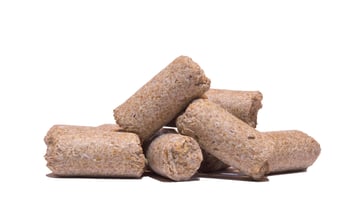
Pelleting:
- The most common processing technology for shrimp feed and many fish feeds.
- Can achieve excellent water stability when formulation, conditioning, pelleting parameters and post-conditioning are properly managed.
- Pellet binders are often used to further improve water stability and pellet durability.
Learn more here: Your Guide To Pelleting
Extrusion:
- Offers greater flexibility to control feed characteristics such as density, buoyancy and water stability.
- Typically produces highly water-stable feed due to the combination of cooking, starch gelatinisation and process control.
- Particularly suitable when very small pellets or specific pellet characteristics are required.
- Requires more process control and generally involves higher operating costs than pelleting.
Which technology is best?
There is no single answer. Both pelleting and extrusion can produce high-quality, water-stable shrimp feed when properly designed and operated. While extrusion offers greater flexibility and control over feed characteristics, pelleting remains an excellent and cost-effective solution in many applications.
Ultimately, water stability depends not only on the choice of processing technology, but also on factors such as formulation, raw materials, conditioning, process control and overall feed production strategy.
9. Why Is Intact Aqua Different?
Intact Aqua is a new, sustainable binder and alternative to PMC, developed to deliver consistent water stability without the health, safety, or regulatory concerns associated with formaldehyde-based products.
It provides improved process performance, fines reduction, and flexibility across raw materials and feed formulations — supporting both shrimp and other aquafeed applications.
Life Cycle Assessment: Reduce your CO2 footprint with Intact Aqua
10. Conclusion
Water stability is rarely perfect — and in aquafeed production, small variations in raw materials or processing can make a big difference. The right binder can help maintain consistent pellet quality, even under challenging conditions. Each feed type has its own stability needs, and selecting a safe, effective, and sustainable binder can ensure reliable performance and measurable results over time.