PLANT NUTRITION

Optimising Granule Quality, Production Efficiency and Storage Stability

Bio-based commodity binders such as molasses and vinasse are widely used in granulation for their cost efficiency, sustainability profile, and reliable binding performance. However, with these binders, maintaining granule quality and process stability during production and storage remains a key challenge for formulators.

Borregaard's lignosulfonate-based binder solutions help fertilizer producers improve granule strength, storage stability, process efficiency and formulation economics.

Key challenges include

  • Moisture sensitivity and storage stability: Hygroscopic binders can absorb moisture during storage and transportation, leading to reduced granule strength, increased breakage, dust formation, and caking.

  • Balancing cost and performance: Lower-cost binders often require higher rates that dilute fertilizer content and reduce granule strength, while high-performance synthetic binders can significantly increase formulation costs.

  • Process efficiency and consistency: Variations in raw materials, slurry viscosity, moisture levels, and operating conditions can affect throughput, energy consumption, and granule uniformity, requiring frequent process adjustments.

Contact us to improve your granule performance

Our products

How our products improve granulation performance


Our lignosulfonates are highly versatile binders that address both performance and cost challenges in fertilizer granulation. They can be used as a standalone solution or combined with other binder systems to optimise granule quality and overall formulation efficiency.

Stronger, more durable granules

Reliable strength and reduced moisture sensitivity ensure durable granules and improved storage stability.

Optimised cost-performance

Flexible formulation options enable optimised cost-performance balance without compromising quality.

Process efficiency & throughput stability

Stable and predictable performance supports higher throughput, lower variability, and improved process efficiency.

Trial data

Improving strength and storage stability under humid conditions

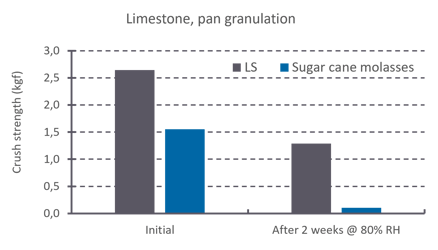
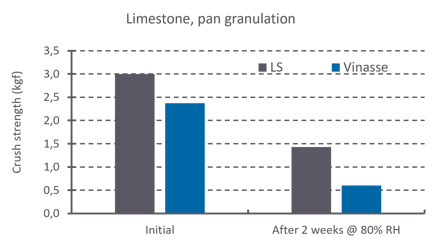
Trial results show that lignosulfonate-based binders deliver higher initial crush strength at a given dosing rate compared to sugar-based alternatives. In addition, granules produced with lignosulfonates maintain their strength far better over time, showing significantly less degradation under accelerated aging in high-humidity conditions than those bound with molasses or vinasse.
limestone_sugarcane

limestone_vinasse

Trial data

Optimising cost vs. performance

Lignosulfonates are highly versatile binders that can be used alone or in combination with inorganic or synthetic binders, such as clay and PVA. Combining lignosulfonates with other binder technologies often provides the optimal balance between granule performance and formulation cost.

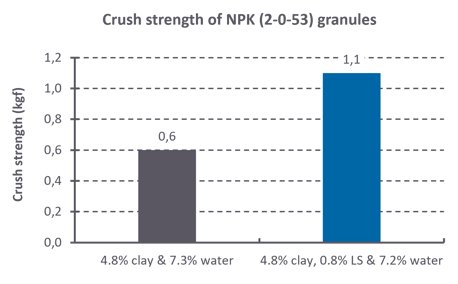
Clay is a cost-effective binder that can support fertilizer granulation with low water addition, helping reduce or eliminate the need for a drying stage after granulation. However, clay alone often delivers insufficient granule strength for demanding storage and handling conditions.
crush strenght granules

As demonstrated in the trial data, combining lignosulfonates with clay significantly improves granule strength while maintaining a cost-efficient binder system.

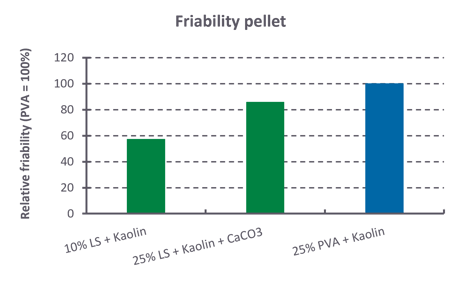
In seed pelleting trials, a lignosulfonate/mineral binder system achieved friability comparable to a PVA-based formulation. Lower pellet friability indicates better binding performance and improved pellet durability, demonstrating that lignosulfonates can provide a cost-effective alternative to synthetic polymers while maintaining formulation performance.
friability pellet

Seed pelleting trials showed that a lignosulfonate-based mineral binder system (Treatment 2) achieved pellet friability comparable to a PVA-based formulation (Treatment 6), indicating equivalent binding performance and pellet durability.

Trial data

Improving process efficiency and consistency

Lignosulfonates are robust, high-performance binders widely used in the granulation of fertilizers, gypsum, limestone, and organofertilizers. They provide predictable granule strength with a linear response to dosage, enabling more consistent process control.

Thanks to their dispersant properties, lignosulfonates also function as effective plasticizers in extrusion processes, reducing slurry and paste viscosity during processing. This enables higher throughput, lower energy consumption, reduced water demand and shorter drying times.

Improved processability demonstrated in trial

As shown below, lignosulfonates improve extrusion efficiency and process robustness across varying formulation conditions.

  • Higher extrusion rates compared to naphthalene sulfonate condensates (NSC)
  • Stable processing across a broader range of slurry moisture
  • Improved process flexibility and throughput efficiency
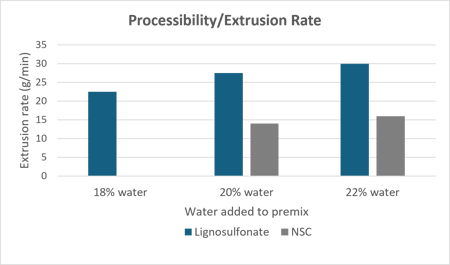
extrusion rate

Contact our experts to learn more about these trials and how our binder solutions can help optimise your granulation process.

Frequently asked questions

  • What is the best binder for NPK fertilizer granulation?

    The optimal binder depends on fertilizer composition, process conditions, target granule properties and cost requirements. Lignosulfonates are highly versatile binders that can be used alone or in combination with inorganic binders or synthetic polymers to optimise both granule quality and cost performance. Reach out to our team to learn what is the best binder for your specific formulation.

  • Can different binders be combined in the same formulation?

    Yes. Combining lignosulfonates with clay, inorganic acids or synthetic polymers is a common approach to balance granule strength, processability and formulation cost. In many cases, these combinations provide better overall performance than using a single binder alone.

  • Why do my fertilizer granules break during handling or transport?

    Poor granule strength is often caused by insufficient binder performance, inadequate moisture control or suboptimal process conditions. Selecting the right binder system can significantly improve granule integrity, reducing dust generation and product losses during storage, transport and application.

  • How can I optimise binder cost without compromising granule quality?

    Using the lowest-cost binder is not always the most economical solution. Higher-performance binders may require lower application rates and produce stronger granules, but can increase formulation costs. Combinations of lignosulfonates with lower-cost binders often deliver the best balance between formulation cost and performance.

  • How much binder should I use?

    The optimal dose depends on the fertilizer composition, production process, moisture level and target granule properties. Laboratory and pilot-scale trials are recommended to determine the most cost-effective dosing rate.


  • How does your binder affect granule density and disintegration?

    Lignosulfonate binders improve particle adhesion while maintaining good granule integrity. Depending on the formulation and dosage, they can help optimise granule density, mechanical strength and disintegration characteristics to meet specific application requirements.

Ready to Improve Granulation Performance?

Contact our team to discuss your formulation requirements and receive technical support, trial data, or product samples.