.png?width=517&height=128&name=Group%20(2).png "Group (2)")
Avoiding leaf scorching and enhancing crop yield
 Marasperse AG is suitable for micronutrient complexed solutions. The soluble metal content it can complex is above the required limits in the EU Fertilising Products Regulation, and its metal complexing rate is in line with the same regulation.
Formulating micronutrient fertilizers with Marasperse AG will ensure proper nutrient availability for plant uptake. As a result, Marasperse AG improves micronutrient use efficiency by the plant, which frequently translates to crop yield increase.
When used via foliar application, Marasperse AG helps avoid leaf scorching even under dry conditions. It ensures proper leaf levels of trace elements like iron, copper, manganese or zinc all season long, providing a stable and constant release of complexed micronutrients to the leaves.
Easy to use
Marasperse AG can be applied via foliar, fertigation or soil dressing. It biodegrades slowly but steadily via soil microbial activity, contributing to natural soil cycles and mechanisms. The product also provides a source of soluble organic carbon and soluble sulfur, necessary requirements for healthy crops, turf and ornamentals.
A sustainable alternative to synthetic chelating agents
Designed to support sustainable agriculture, Marasperse AG biodegrades gradually through natural soil microbial activity, contributing to healthy soil processes and nutrient cycling. In addition to improving micronutrient complexation, it also provides a source of soluble organic carbon and sulfur, supporting healthy crops, turf, and ornamentals.
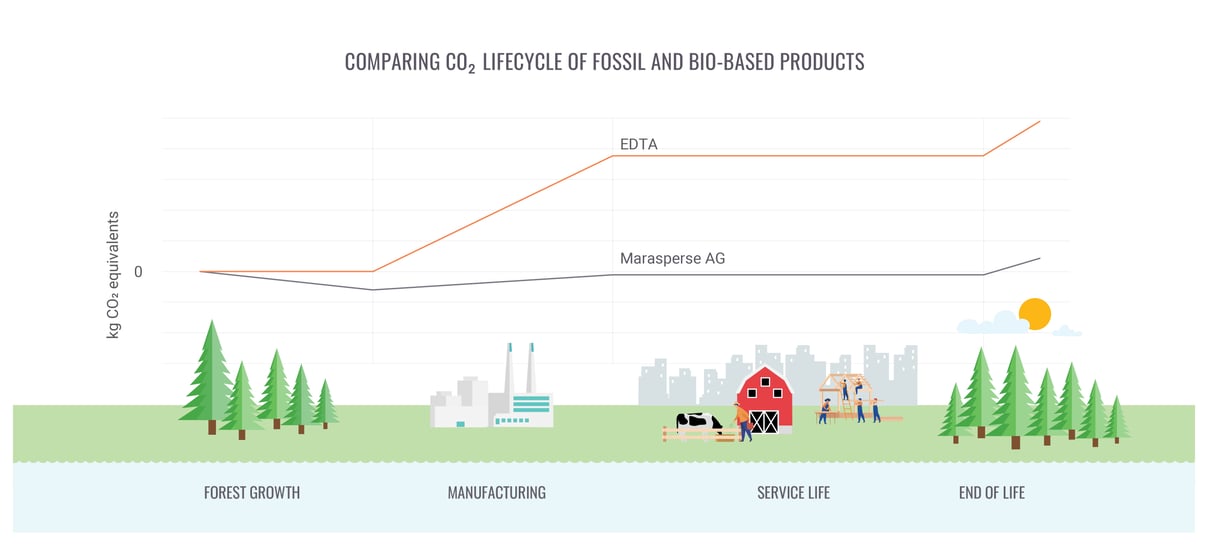
Marasperse AG is approved as a complexing agent for micronutrients in most countries and is OMRI listed for use in organic farming systems. A life cycle assessment (LCA) conducted by NORSUS comparing Marasperse AG with EDTA (ethylenediaminetetraacetic acid). The study concluded that Marasperse AG is the more sustainable alternative and that replacing EDTA with Borregaard’s complexing biopolymer in Zn and Mn applications for tangerines (see dosage comparison here) can reduce CO₂ emissions by up to 100%.
The superior stability of Marasperse AG translates into improved agronomic performance. Greenhouse and field trials show that micronutrients complexed with Marasperse AG are absorbed and translocated more effectively after foliar application.
Chemical Performance
Phenolic hydroxyl (-OH) groups help maintain micronutrient solubility and reduce displacement by calcium in calcareous soils and hard water. Gluconates, heptagluconates, and amino acid-based complexes, which rely primarily on carboxylic (-COOH) and amine (-NH₂) groups, do not provide the same level of stability.
To simulate calcareous soil and hard water tank-mix conditions, iron and zinc solutions (2 mM) were prepared at different pH values in the presence of 100 mM CaCl₂. Under these conditions, lignosulfonate-based formulations maintained a higher percentage of iron and zinc in solution than gluconate- and amino acid-based formulations.
This enables formulators to maximize micronutrient loading without compromising stability, even under challenging conditions.
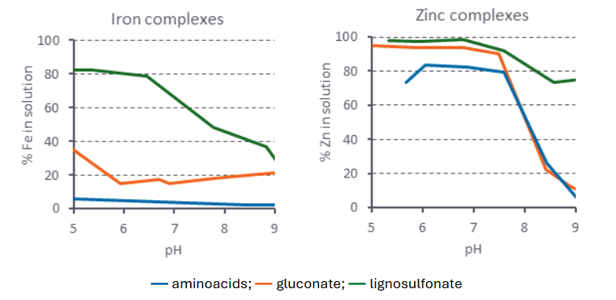
% Soluble micronutrient remaining in solution after 3 days storage. Data digitized and reconstructed from: J. J. Lucena et al. J. Plant Nutr. Soil Sci. 2010, 173 (6), 900-906
Pot trial results
In soybean pot trials, iron complexed with lignosulfonates resulted in significantly higher root iron concentrations 22 days after foliar application than gluconate- and amino acid-based complexes. These results indicate that the greater stability of lignosulfonate complexes enhances nutrient uptake and translocation within the plant.
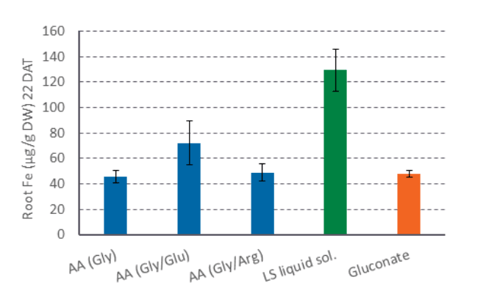 AA: aminoacid; Gly: glycine; Glu: glutamate; Arg: arginine; LS: lignosulfonate - Data digitized and reconstructed from: J. J. Lucena et al. J. Plant Nutr. Soil Sci. 2010, 173 (1), 120-126
Field Trial Results
Similar results were observed in an open-field peach trial conducted by IRTA in Lleida, Spain. Both treatments significantly increased foliar iron and manganese compared with the untreated control, but Marasperse AG delivered higher uptake than heptagluconate, with a statistically significant advantage for manganese.
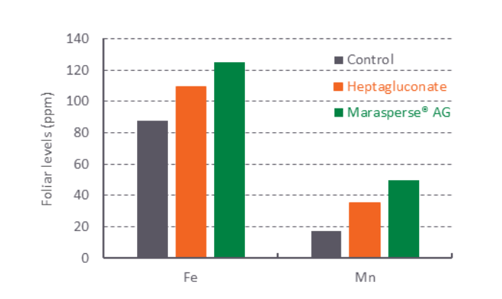 Foliar levels measured 8 days after spray application to deliver 0.2 kg/ha of Fe & Mn - Peach foliar trial, IRTA Lleida, Spain
These results confirm that the unique chemistry of Marasperse AG improves micronutrient stability, enhances foliar absorption, and promotes nutrient movement within the plant.
In addition to its complexing capacity, Marasperse® AG offers other functionalities that are key to ensuring proper micronutrient foliar uptake and understanding its superior performance in the field.
Marasperse AG is a lignin-based biopolymer with natural surface-active tension properties, which provide a good distribution of the micronutrient over the leaf surface without the need for additional adjuvants.

Marasperse AG reduces surface tension of the foliar spray.
In foliar nutrition, the key is to keep the nutrient in a water-soluble form to ensure diffusion, leaf penetration and prevent crystallisation or precipitation, which can lead to leaf scorching.
Marasperse AG is a hygroscopic biopolymer. It helps keep nutrients in a water-soluble form so that they can diffuse and penetrate into the leaves, even in low humidity environments.
A zinc (Zn) sulfate spray residue remains dry in a low humidity environment (33% RH) while Zn sulfate formulated with Marasperse AG is able to capture humidity from the air and remain moist and active for foliar uptake.
Field demonstrations with Marasperse AG on tangerine trees show increased uptake of nutrients and a higher yield compared to simple metal salts and chelated micronutrients.
This work was conducted at Institute of Agrifood Research and Technology (IRTA) in Deltebre, Spain. The tangerine variety ‘De Nules Clementine’ was used. Two foliar treatments of 0.35 kg/ha Zn and Mn were applied in periods of maximum vegetative growth to prevent micronutrient deficiencies during the season. Yield and foliar levels of Zn and Mn were recorded during the trial to assess the agronomic efficiency of different micronutrient sources (EDTA, sulphates and Marasperse AG). Results were compared with an untreated control.
Key takeaways:
-
16% higher yield per clementine tree with Marasperse AG
-
Long-lasting availability of micronutrients
-
Stable and continuous release of complexed micronutrients to the leaves over time
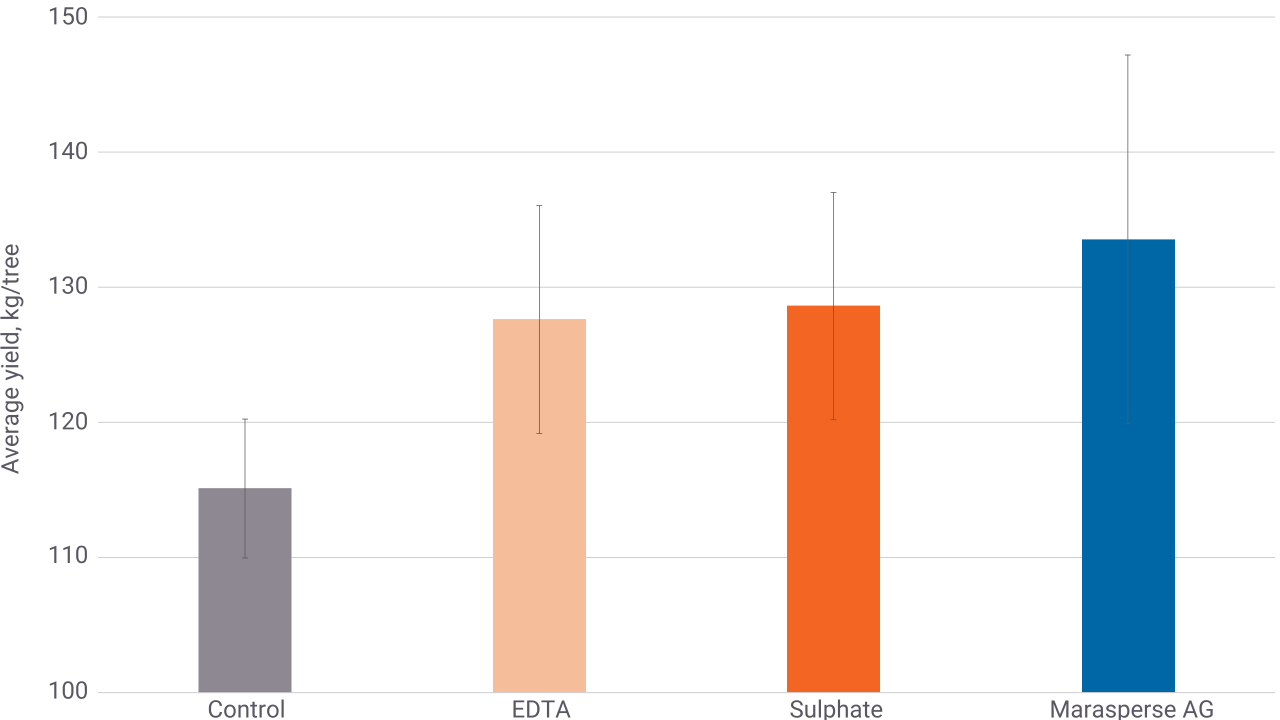
Average tangerine yield with different trace element sources.
Iron foliar level in tangerine leaves achieved with Marasperse AG compared to EDTA and control.
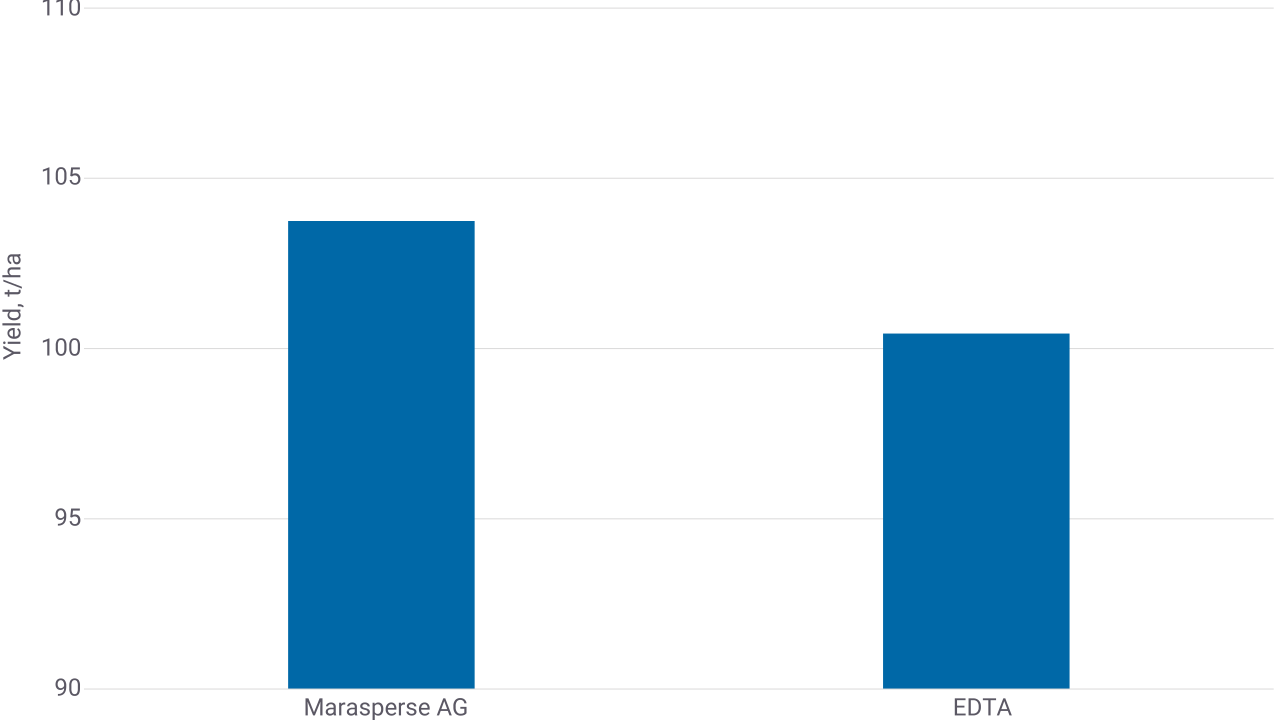
Field demonstrations in a soil application for tomato crops show the benefits of Marasperse® AG under alkaline soil conditions with high demand for iron micronutrient. Marasperse AG increased tomato crop yield over an EDTA chelating agent.
This work was conducted by Syntech Research in Andalusia, Spain. Under greenhouse fertigation conditions, the tomato crop received weekly applications of Fe, Zn, Mn, Cu, Mo and B containing fertilizers. The comparative study between fertilizers with Marasperse AG and a formulation with a synthetic chelate (EDTA) evaluated iron foliar level and the agricultural yield.
Key takeaways:
-
Tomato crop yield increase over EDTA
-
Micronutrient uptake similar to synthetic chelates
-
OMRI listed as complexing agent
Yield results with fertilizers containing different complexing agents.
Iron foliar level over time with fertilizers containing different complexing agents.