.png?width=517&height=128&name=Group%20(2).png "Group (2)")
Exilva® for
Caulks & Sealants
Borregaard's bio-based rheology modifier for smoother application and reliable performance
Achieving the right rheology in waterborne caulk and sealant formulations requires a careful balance between easy extrusion, sag resistance, storage stability and consistent application across temperatures.
Exilva®, Borregaard's bio-based microfibrillated cellulose (MFC), provides shear-thinning rheology that helps formulators achieve this balance.
LOWER APPLICATION PRESSURE
Strong shear-thinning behaviour allows easier extrusion and noticeably smoother application in caulks and sealants.
IMPROVED COLD-WEATHER EXTRUDABILITY
Maintain application performance even at lower temperatures where conventional sealant formulations may struggle.
REDUCE RELIANCE ON SYNTHETIC ADDITIVES
Exilva enables replacement of conventional synthetic rheology modifiers while contributing additional performance benefits.
ADD RENEWABLE CONTENT
Produced from wood-based cellulose, Exilva helps increase bio-based content while delivering measurable improvements in sealant formulations.
Faster extrusion at room and low temperatures
In laboratory testing, a water-based sealant formulation containing Exilva was compared with a reference formulation under identical extrusion conditions. Extrusion rate was measured at a constant pressure of 3 bar at both room temperature (22°C) and refrigerated temperature (4°C).
The Exilva-containing formulation achieved a 48% higher extrusion rate at 22°C and a 23% higher extrusion rate at 4°C, demonstrating improved workability across different application temperatures.
Extrusion rate measured as grams extruded per minute at 3 bar pressure:
| Temperature | Improvement |
| 22°C (Room temperature) | +48% |
| 4°C (Refrigerator temperature) | +23% |
Faster extrusion translates into smoother application and reduced effort for end users, particularly in colder environments where many sealants become difficult to apply.
Video:
Demonstrating Sealant Extrusion Rate with Exilva®
This video demonstrates the impact of Exilva® microfibrillated cellulose (MFC) on the extrusion performance of a water-based sealant formulation. The test compares a reference sealant with an Exilva-modified formulation under identical conditions. Both samples are extruded from a pneumatic caulking gun at a constant pressure of 3 bar for 30 seconds, and the amount of sealant extruded is measured in grams.
After four months of storage, the Exilva-containing sealant shows a substantial improvement in extrudability compared with the reference formulation. This indicates very promising extrusion performance and storage robustness.
Easier application without sacrificing stability
Many sealants become difficult to extrude as temperatures drop. Exilva helps maintain smooth application across a wider temperature range by reducing viscosity under high shear while preserving the structure needed for storage stability and sag control.
The result is a sealant that is easier to apply while remaining stable in the cartridge.
Strong shear-thinning performance
Exilva creates a highly efficient rheology profile:
- High viscosity at rest for storage stability
- Lower viscosity during application
- Fast recovery after extrusion
- Consistent performance across temperatures
This allows formulators to improve workability while maintaining the performance characteristics required in professional sealant applications.
What improved extrudability can mean at scale
The most significant cost is often the least visible: lost installation time. Even modest improvements in extrusion performance can translate into meaningful productivity gains across large production volumes and thousands of installations.
Illustrative calculation based on the measured 48% improvement in extrusion rate at 22°C and an assumed production/application scenario. Actual productivity gains depend on cartridge size, application conditions, equipment and formulation:
| Parameter | Typical value |
| Extrudability improvement | + 48% |
| Time saved per cartridge | ~ 21 sec |
| Medium producer output | 10M cartridges |
| Potential productivity gain | ~ 58,000 hours |
Material cost per cartridge is typically only a fraction of the total installed cost. Improving application efficiency impacts the most expensive part of the system: labour.
How Exilva works
Microfibrillated cellulose technology
Exilva consists of a network of cellulose microfibrils that creates viscosity and structure throughout the formulation.
Under shear, this network temporarily aligns and allows easier flow. Once the shear force is removed, the network rebuilds rapidly.
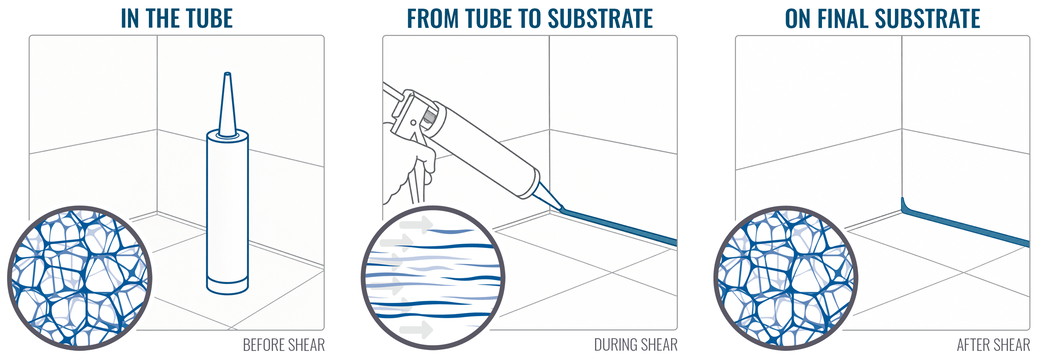
This unique behaviour enables:
- Easy application
- Good sag resistance
- Long-term viscosity stability
- Reliable performance throughout storage and use
Ready to Evaluate Exilva?
Whether your goal is improved workability, better low-temperature performance, reduced synthetic additive use, or increased renewable content, Exilva offers a versatile solution for modern sealant formulations.
Request a sample or speak with our technical team to discuss your formulation challenges:
Frequently Asked Questions
-
What is a rheology modifier for sealants?
A rheology modifier controls how a sealant flows under different levels of shear. An effective rheology profile provides sufficient structure at rest for stability and sag resistance while allowing easier flow during extrusion and application.
-
How can extrusion force be reduced in a sealant?
Strong shear-thinning behaviour can reduce apparent viscosity during extrusion, allowing the sealant to flow more easily through the cartridge nozzle while maintaining higher viscosity at rest.
-
How does microfibrillated cellulose improve sealant rheology?
Microfibrillated cellulose forms a three-dimensional fibril network that provides structure at rest. Under shear, the network aligns and viscosity decreases. After shear is removed, the network rapidly rebuilds, supporting sag resistance and stability.
-
Can Exilva improve sealant application at low temperatures?
In Borregaard testing, an Exilva-containing water-based sealant showed a 23% higher extrusion rate at 4°C compared with the reference formulation under the same test conditions.
-
Can Exilva replace synthetic rheology modifiers in sealants?
Depending on the formulation requirements, Exilva can partially or fully replace conventional rheology modifiers while providing additional benefits from its shear-thinning and stabilising properties. Borregaard also describes this multifunctionality across coating and adhesive formulations.