.png?width=517&height=128&name=Group%20(2).png "Group (2)")
Your guide to agglomeration of process fines
Introduction
Process fines can create challenges across production — from handling and transport, to optimised throughput, product quality and consistency. At the same time, these materials often still have significant value. The challenge is to make them usable in a stable and efficient way.
Agglomeration addresses this by converting fine particles into larger, more stable forms such as briquettes, pellets, or granules. This can improve handling, reduce material losses, and support more consistent downstream performance.
This guide explains:
• what agglomeration of process fines is
• why companies agglomerate fines
• which process routes and binder systems are used
• what factors influence performance
• and how to approach process and binder selection
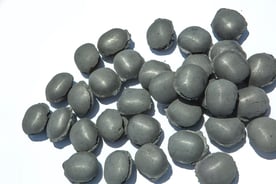
Table of contents
- 1. What is agglomeration of process fines?
- 2. Why agglomerate fines?
- 3. What agglomeration processes exist?
- 4. When is a binder needed?
- 5. What types of binders are used?
- 6. What factors influence agglomeration performance?
- 7. Which materials can be agglomerated?
- 8. How do you choose the right binder and process?
- 9. What proof should you look for?
- 10. What are the next steps?
1. What is agglomeration of process fines?
In many industrial and metallurgical processes, materials are generated or handled as fine particles. These fines can be difficult to store, transport, feed into processes, or reuse efficiently.
Agglomeration is the process of converting these fine particles into larger aggregates such as briquettes, pellets, or granules.
The purpose of agglomeration is not only to change particle size. It is to improve how the material behaves — during production, in handling, and in downstream use.
2. Why agglomerate fines?
Fine materials often create practical and economic challenges since they can cause handling issues or reduce process stability. In some cases, they also limit how much value can be recovered from the material.
Agglomeration helps address these challenges by creating a more stable product form.
Companies typically agglomerate fines to:
• gain more value from fine materials
• improve strength and durability
• improve handling and transport
• reduce dust and material losses
• improve storage stability
• support a more stable and efficient process operation
In practical terms, agglomeration makes fine materials easier to manage and easier to use.
3. What agglomeration processes exist?
There are several ways to agglomerate process fines. The most suitable method depends on the material, the required product form, and how the agglomerate will be used downstream.
Some processes rely mainly on pressure, while others depend on motion or heat.
Pressure agglomeration
Briquetting
Briquetting compresses fines into compact shapes under pressure. It is typically used when strong and dense agglomerates are required for handling, transport, or further processing.
Pelleting
Pelleting produces smaller and more uniform agglomerates. This is often useful where controlled size, flow behaviour, or consistent feeding is important.
Extrusion
Extrusion forms material by pushing it through a die, creating a continuous shape that is then cut into pieces. It is suitable when a defined geometry is required and the material can be shaped under pressure.
Non-pressure agglomeration
Granulation
Granulation builds particles into larger granules through rolling or tumbling. It is commonly used when the goal is to produce stable granules rather than compact shapes.
Sintering
Sintering is a thermal process where particles are bonded by heat. Bonding is achieved through elevated temperature.
________________________________________
The best process depends on how the material behaves and what the final product needs to achieve. Process selection and binder selection should always be evaluated together.
4. When is a binder needed?
A binder is not required in every agglomeration process, but in many cases it is essential to achieve stable results.
Some materials can form agglomerates naturally. However, this is not always sufficient when higher strength or durability is required.
A binder is typically needed when:
• the material does not naturally form a stable structure
• high agglomeration strength is required to withstand handling, transport, or storage
• the process needs better stability or consistency
Binders act as a bonding agent between particles. They improve both early-stage strength and final strength after drying or curing.
The need for a binder should always be assessed in relation to material properties, process conditions, and performance requirements.
5. What types of binders are used?
A wide range of binder systems can be used in agglomeration. The most suitable choice depends on the material, process, and performance targets.
Binder types are commonly grouped into inorganic and organic systems.
Inorganic binders
Inorganic binders are widely used in industrial processes. Typical examples include:
• bentonite and other clay-based binders
• sodium silicate
• cement
• lime
These binders are often selected where:
• mineral compatibility is important
• cost is a key factor
• or the process is already established
At the same time, they may influence the composition of the final product, for example through ash contribution or chemical impact.
Organic binders
Organic binders provide an alternative approach and are used in many applications. Examples include:
• lignosulfonate / lignin-based binders
• starch
• molasses
• polymer-based systems such as CMC or polyacrylamide
• natural polymers such as guar gum or humic acids
These binders may be preferred when:
• lower inorganic content is required
• specific strength behaviour is needed
• process conditions favour organic systems
• sustainability is a consideration
Borregaard’s solutions are based on lignosulfonate / lignin-based binders, which are used to improve strength, durability, and handling performance across a range of applications.
In practice, binder selection should be based on overall system performance — not a single parameter.
6. What factors influence agglomeration performance?
Agglomeration performance depends on several interacting factors. There is rarely one single parameter that determines whether a solution performs well.
For this reason, performance should be evaluated in a structured way.
Key factors include:
• Strength and durability, which determine whether the agglomerate can withstand handling and transport
• Fines generation, which affects material losses and dust formation
• Storage stability, which defines how well the agglomerate retains its properties over time
• Porosity and reactivity, which can influence downstream processing
• Thermal behaviour, especially when the material is exposed to drying or high temperatures
• Process performance, including throughput and stability
• Chemical constraints, such as sulfur and ash contribution
These factors are closely linked. Improving one may influence others.
The most effective solution is the one that provides a balanced performance across all relevant criteria.
7. Which materials can be agglomerated?
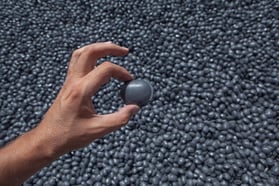
A wide range of solid materials can be agglomerated. However, how easily this can be done depends on the properties of the material and the requirements of the application.
In industrial applications, agglomeration is commonly used for:
-
ore and mineral fines
-
carbon-based materials
-
metallurgical by-products and process residues
-
biomass and wood fines
Examples include iron ore fines, copper fines, zinc fines, carbon fines, petcoke, graphite, mill scale, and other industrial process residues.
While these materials differ, the underlying challenge is often similar: converting fine particles into a stable and usable form.
What matters most is how the material behaves, including particle size, chemistry, and interaction with moisture and binders. These characteristics influence both process selection and binder selection, which is why testing and evaluation are often important parts of an agglomeration project.
8. How do you choose the right binder and process?
Selecting the right agglomeration solution requires a system perspective.
It is important to consider the material and its variability, the required product form, the performance requirements, and the process conditions.
Typical evaluation questions include:
-
What strength and stability are required?
-
How will the material be handled and used?
-
Which process is most suitable for this material?
-
Are there constraints related to ash, sulfur, or sustainability?
The answers to these questions help narrow the range of suitable process and binder options. However, technical performance is only one part of the evaluation.
Cost should also be evaluated in context. The most cost-effective solution is the one that delivers the best overall process performance — not necessarily the lowest binder cost.
In practice, the right solution is usually identified through a combination of technical assessment and testing.

9. What proof should you look for?
Performance data is an important part of evaluating binder solutions. However, not all proof is equally relevant.
When reviewing results, it is important to consider:
- the material used in testing
- the process conditions
- how performance develops over time
- how well the test reflects your own process
Results from one application cannot always be transferred directly to another.
Borregaard provides application-specific examples that illustrate how binder performance depends on material and conditions.
10. What are the next steps?
If you are evaluating agglomeration of process fines, the next step is typically to understand your own material and process requirements in more detail.
This may include:
- defining performance targets
- assessing whether a binder is needed
- reviewing relevant process and binder options
- planning trials or testing
A structured approach makes it easier to identify the most suitable solution.
Need support evaluating your material or process?
Selecting the right agglomeration solution often requires balancing material properties, process conditions, performance targets, and operational requirements. Borregaard's technical experts can help evaluate your application and discuss potential approaches based on your specific material and objectives.