
PARTIAL REPLACEMENT OF BENTONITE IN IRON ORE PELLETISING
PERFORMANCE AT A Full-scale production trial at a pellet plant in South Asia
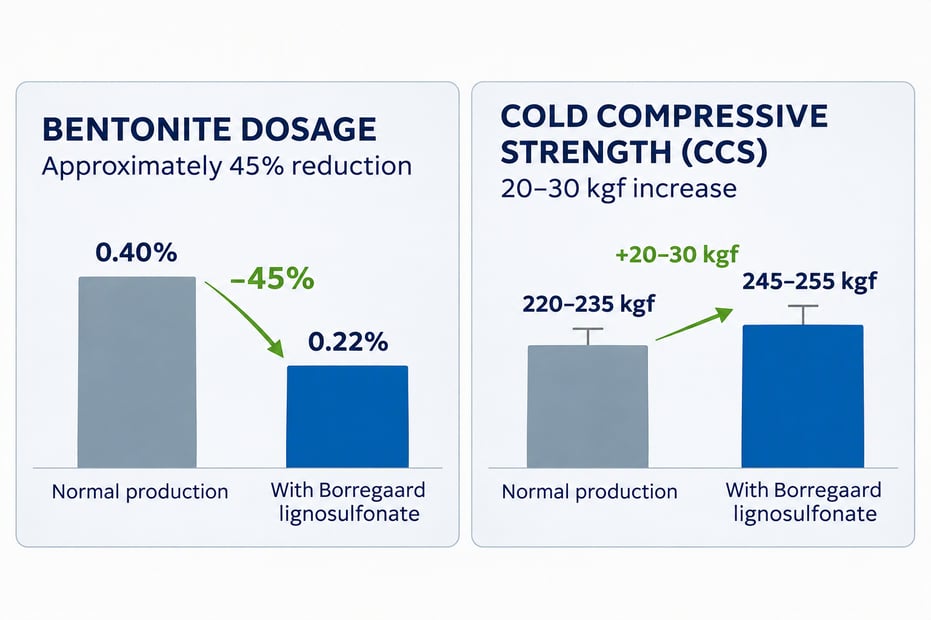
A major iron ore pellet producer in South Asia evaluated Borregaard lignosulfonates as a way to reduce bentonite consumption while maintaining process performance and improving pellet quality. In a full-scale production trial, bentonite dosage was reduced by approximately 45%, while pellet CCS increased by approximately 20–30 kgf (kilograms-force).
The challenge
Bentonite is a well-established binder in iron ore pelletising, but it also introduces silica into the pellets. The producer therefore wanted to reduce bentonite consumption without compromising pellet strength or production stability.
The plant trial
During the plant trial, bentonite dosage was reduced from approximately 0.40% to 0.22%, while Borregaard lignosulfonate binder was added at approximately 0.16%. At the same time, Cold Compressive Strength (CCS) increased from a normal production level of approximately 220 kgf to around 250 kgf.
Key results
- Approximately 45 % reduction in bentonite dosage
- 20–30 kgf increase in CCS
- Stable production during the trial
- Validated under full-scale production conditions
|
Parameter |
Normal production |
With Borregaard lignosulfonates |
|---|---|---|
|
Mixer feed (t/h) |
610 |
550 |
|
Bentonite (%) |
0.40 |
0.22 |
|
Borregaard lignosulfonate binder (wt %) |
0 |
0.16 |
|
Cold Compressive Strength (kgf) |
220 - 235 |
245 - 255 |
|
Tumble index (%) |
93.8 - 94.5 |
94.0 - 94.5 |
|
Sulphur (%) |
0.0018 |
0.0038 |
Summary
The results demonstrate the potential of Borregaard lignosulfonates as a partial replacement for bentonite in iron ore pelleting. Bentonite dosage was reduced by approximately 45%, while pellet strength increased and plant operation remained stable.