.png?width=517&height=128&name=Group%20(2).png "Group (2)")
Why good slurry wetting and attachment to the current collector matter
In battery electrode manufacturing, it is not enough for a slurry to simply flow through the coating head and land on the current collector. It also needs to wet the surface properly and create intimate, uniform contact from the very beginning. This first contact between slurry and foil is crucial, because it strongly influences coating stability, film uniformity, interfacial quality, and ultimately electrode performance. A slurry that wets well spreads more evenly, anchors better to the moving foil, and gives the process a stronger starting point. A slurry that wets poorly does the opposite: it increases the risk of instability already at the moment of coating. This is especially important because copper foil is not perfectly flat at the microscopic scale. Even when it looks smooth to the eye, its surface contains small peaks, valleys, and texture, so the slurry must wet not only a flat plane, but also penetrate and conform to this fine surface roughness.
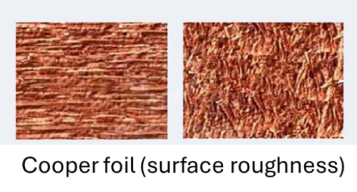
This is particularly important in slot-die coating, where the slurry must form a stable bead and maintain continuous contact with the current collector while the web is moving. If wetting is insufficient, the slurry can retract locally instead of spreading smoothly. That can lead to defects such as partial dewetting, thickness non-uniformity, rivulets, ribbing, or even film breakup. Once such defects are created in the wet film, they are difficult to remove later. Drying and calendering may compress the structure, but they cannot fully undo a poor slurry-to-foil interaction established at the coating stage. In that sense, wetting is not a secondary detail; it is one of the foundations of robust coating.
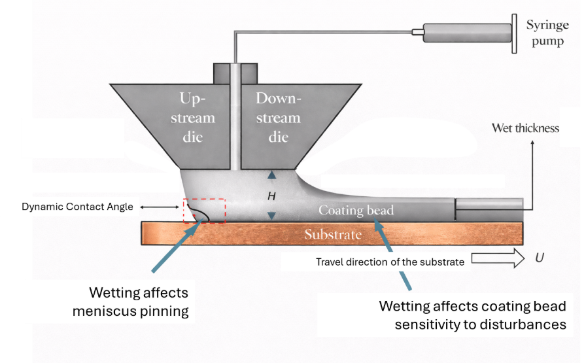
A major challenge is that some commonly used slurry components are not ideal from a wetting perspective. CMC is widely used because it contributes useful rheological structure, helps stabilize particles, and plays an important role in the mechanical integrity of the dried electrode. However, CMC-rich systems do not necessarily provide the best wetting on the current collector. In practice, this can create a trade-off. On one side, CMC helps build viscosity, network strength, and handling stability. On the other, it can contribute to higher contact angles and less favourable spreading on copper. That means a slurry can be mechanically structured and still not interact optimally with the foil surface during coating.
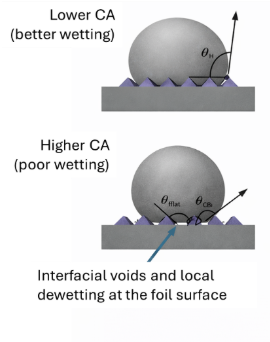
This is where formulation strategy becomes important. Instead of relying on CMC alone, it can be advantageous to combine it with other dispersants that support better wetting. The goal is not to remove the strengths of CMC, but to reduce its downside at the slurry–collector interface. A well-chosen co-dispersant can help lower the contact angle, improve spreading, and strengthen meniscus stability, while CMC continues to contribute to cohesion and dry-electrode integrity. In other words, the formulation can move from being dominated by one function to being balanced across several: dispersion, rheology, coating stability, and interfacial contact.
This matters because good wetting is closely linked to good attachment quality in the wet state. When the slurry spreads properly over the copper surface, it is more likely to create a more continuous and intimate interface, with fewer local voids, uncovered spots, or weakly contacted regions. This point becomes even more relevant when considering the microscopic roughness of the copper foil: if the slurry does not wet well enough, it may bridge over parts of the surface texture instead of conforming to it, leaving small interfacial gaps behind. That is highly relevant for electrode quality. The current collector is the electronic backbone of the electrode, and poor local contact at this interface can contribute to uneven current distribution, local resistance variations, and mechanically weaker regions. Good wetting therefore helps not only the coating process itself, but also the quality of the interfacial architecture that the final electrode is built on.
At the same time, it is important to describe this correctly: wetting and final adhesion strength are not identical. Stronger wetting in the wet stage does not automatically mean the highest peel strength after drying, since final adhesion is also strongly governed by binder chemistry, binder distribution, and drying history. Still, better wetting provides a much better starting condition. It reduces the likelihood of interfacial defects and helps create a more homogeneous interface before the electrode is dried. That is valuable in itself, because many later problems in battery manufacturing begin as small non-uniformities in the wet film and then become fixed into the final electrode structure during solvent removal and consolidation.
From a process point of view, this is why the best dispersant is not always the one that just disperses particles, but the one that improves the whole coating situation. A useful dispersant should help particles stay well distributed, but it should also support wetting rather than undermine it. If a dispersant improves flow while worsening slurry attachment to the foil, the benefit can be partly lost during coating. By contrast, when dispersants are selected or combined so that wetting is maintained or improved, the process becomes much more forgiving. The bead is easier to stabilize, spreading becomes more uniform, and the operating window becomes broader. That gives manufacturers more confidence when increasing solids loading, line speed, or coating precision.
For that reason, a strong formulation strategy is to combine CMC with complementary dispersants that do not reduce wetting, and ideally improve it. This approach addresses a real and practical problem: CMC provides many benefits, but wetting is not always one of them. By pairing CMC with other dispersants that promote better slurry–collector interaction, manufacturers can preserve the structural advantages of CMC while improving coatability and interfacial quality. That is a more complete solution than treating slurry design as a viscosity issue alone.
In simple terms, good battery coatings start with good contact. If the slurry wets and attaches well to the current collector, the process is more stable and the electrode begins with a stronger microstructural foundation. If wetting is poor, the coating line must fight the formulation from the first second. That is why wetting should be viewed as a central formulation target, and why combining CMC with other dispersants can be such a valuable route: it transforms a common limitation into an opportunity for better coating robustness, better interfacial quality, and ultimately better electrodes.

