BETTER WET FILMS THROUGH DISPERSANT CONTROL

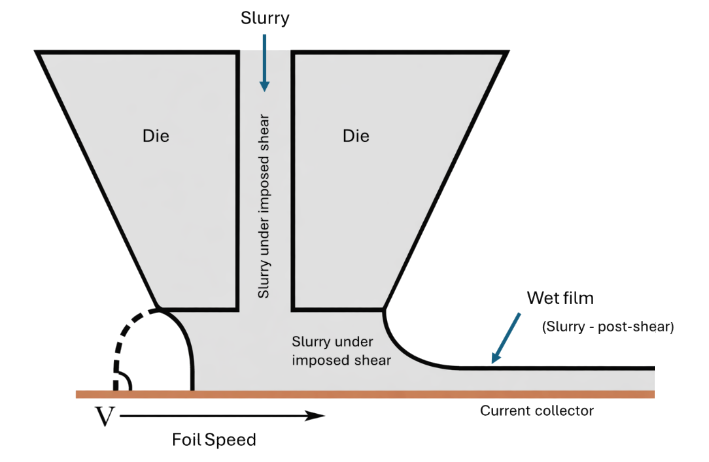
Once a battery slurry leaves the slot die and lands on the current collector, the real balancing act begins. In this post-shear stage, the slurry is no longer under the strong deformation of the coating die head. Instead, it must quickly rebuild enough structure to hold its shape as a wet film, while still retaining enough mobility to level smoothly. This short time window, often only a few seconds before drying starts, is decisive for film quality. If recovery is too weak, the film can sag, slump, or redistribute. If recovery is too strong or too fast, surface irregularities may be locked in before they can level out.
To improve formulations, part of the slurry journey through the process can be replicated in a rheometer through a 3ITT test. It reproduces the slurry’s journey from a structured pre-coating state, through a high-shear coating stage, and into post-shear rebuilding after deposition. What makes 3ITT valuable is that it shows both how fast viscosity returns and how high it returns. Both matter. A slurry that recovers too slowly remains too fluid and risks wet-film deformation. A slurry that overshoots into an overly viscous state may resist levelling and trap defects. In this way, 3ITT provides a practical preview of wet-film behaviour.
For wet-film stability, the target is not simply “faster recovery.” The target is the right recovery profile. The film needs enough rebuilt viscosity and elasticity to resist gravity, edge flow, and thickness variation, but not so much that smoothing is cut short. That is exactly where dispersants make a difference. By adsorbing on particle surfaces and tuning interparticle interactions, dispersants control how the slurry microstructure rebuilds after shear. They influence both the kinetics of recovery and the final recovered viscosity, helping the film find the sweet spot between levelling and shape retention.
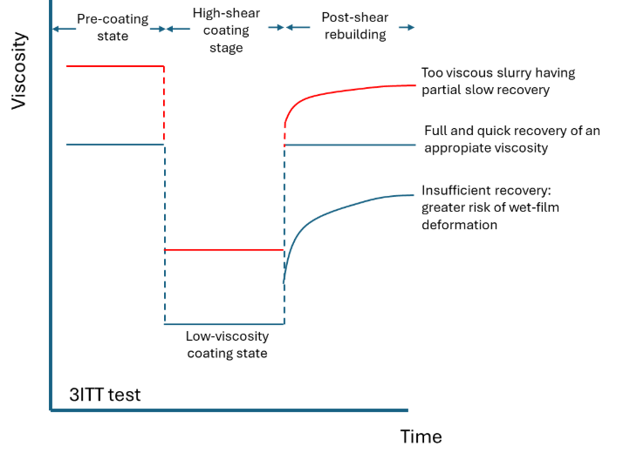
A well-designed dispersant system therefore does more than improve mixing. It actively helps the slurry rebuild in a controlled way after casting: fast enough to stabilize the wet film, but not so abruptly that it freezes surface defects in place. Poor dispersant control pushes the slurry to either extreme. Too little rebuilding leaves the film vulnerable to sagging and deformation; too much or too rapid rebuilding can promote premature solidification, roughness, and non-uniformity.
That is the practical message behind the example. The most attractive slurry is not the one with the highest viscosity after coating, nor the one that stays fluid the longest. It is the one that rebuilds to an appropriate viscosity, quickly and in a controlled manner. For battery manufacturers, that means fewer wet-film defects, more robust coating, and a better path to consistent electrode quality. For dispersants, it means they are not just additives in the recipe; they are key tools for shaping what the film becomes in the seconds that matter most.
Read our PUBLICATION "DEBUNDLING OF SWCNTS USING A NON-TOXIC, LOW CARBON FOOTPRINT DISPERSANT"
Abstract
A fully aqueous, N-methyl-2-pyrrolidone–free strategy for debundling single-walled carbon nanotubes (SWCNTs) is reported using the renewable dispersant Vanisperse® LI. Dispersions at 2 mg mL−1 were subjected to probe ultrasonication at 0.3 W mL−1 and evaluated using oscillatory rheology. Complex viscosity (η*) exhibited a transient maximum (~75 min) consistent with the formation of a percolated fibrous network, followed by a decline as debundling progressed. An optimum dispersant coverage of ~1.5 mg m−2 minimized η*, while overdosing likely induced multilayer adsorption and bridging seen by a rapid increase in η*. A two-stage centrifugation at 10,000× g yielded storage-stable suspensions of debundled SWCNTs without ultracentrifugation. SEM confirmed substantial debundling into thin fiber-like bundles. By formulating a dispersion with a dispersant that has a significantly lower cradle-to-gate carbon footprint than both fossil-based and bio-based alternatives such as CMC, this work presents a more sustainable approach to producing debundled SWCNT dispersions for advanced material applications.
Technical Bulletin: Dispersion of Carbon Nanotubes with Vanisperse LI
Borregaard’s bio-based battery additives are designed for use in water-based electrode slurries and to stabilize aqueous carbon nanotube (CNT) dispersions. Obtained from sustainably sourced wood, our products are non-toxic, environmentally friendly, and highly effective. Vanisperse LI provides a uniquely sustainable alternative and affords a lower CO2 footprint than petroleum-derived additives.
Efficient dispersion of CNTs is critical for achieving uniform electrode composition and optimal battery performance. Sustainable water-soluble dispersants are essential to de-agglomerate CNTs in water, preventing the hydrophobic carbons from reforming agglomerates.
.png?width=517&height=128&name=Group%20(2).png)