.png?width=517&height=128&name=Group%20(2).png "Group (2)")
How Dispersant Dosage Shapes Electrode
Thickness and Structure: Insights from SEM
Imaging
Improved particle dispersion in lithium-ion battery electrode slurries can enable denser particle packing. This can increase mass loading while reducing electrode thickness.
In our tests, the control electrode achieved approximately 9 mg/cm² mass loading. Increasing the dispersant dosage raised mass loading above 10 mg/cm² while electrode thickness decreased.
We achieved these results using Vanisperse LI, our dispersant for water-based electrode slurries.
Cross‑section SEM imaging provides a powerful window into these structural transformations, especially when evaluating how dispersants influence porosity, thickness, and ultimately mass loading.
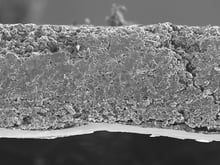
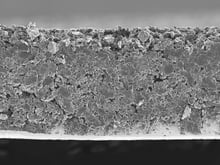
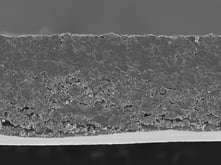
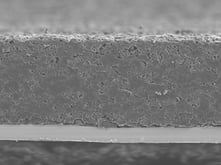
Cross-sectional SEM images of dry electrodes illustrates modified tortuosity and increased coating density with a dispersant. The leftmost image shows a control coating without Vanisperse LI, while subsequent images to the right show coatings with increasing dosages of Vanisperse LI.
Visualizing Structural Differences Through Cross‑Section SEM
SEM cross‑sections reveal clear qualitative differences between control electrodes and those produced with increasing doses of dispersant.
- Control electrodes without dispersant show a characteristic pore structure and packing behavior.
- Electrodes containing dispersant, even at low additions, display noticeable changes in porosity and internal organization.
These visual shifts demonstrate why dosage studies are necessary. A single trial with one dispersant level can easily miss the progression in pore structure and the point at which dispersion begins to significantly reshape electrode morphology.
Increasing Mass Loading Through Improved Dispersion
Quantitative measurements of the same electrodes show a strong correlation between dispersant dosage and mass loading:
- The control slurry without dispersant produced electrodes with ~9 mg/cm² mass loading — typical for current industrial‑scale electrodes.
- As dispersant dosage increased, mass loading rose above 10 mg/cm², entering the next‑generation mass‑loading regime.
This performance gain is tied to improved slurry packing and coating behavior. Enhanced dispersion enables tighter, more uniform particle packing, allowing more active material to be deposited per unit area without compromising coating quality.
Thinner Electrodes at Higher Mass Loading
Interestingly, SEM data also highlights a decrease in electrode thickness as dispersant dosage increases. When paired with the rise in mass loading, this indicates a shift in cast slurry density:
- Higher mass loading + lower thickness → a denser, more efficiently packed electrode.
This densification is a direct outcome of better‑dispersed particles forming a more cohesive structure, filling voids more effectively, and reducing unnecessary thickness while still increasing active‑material content.
Implications for Battery Performance
Any change in electrode microstructure - porosity, density, thickness, or mass loading - will influence electrochemical performance. Denser electrodes with improved particle connectivity can enhance conductivity and ion transport, but formulation balance remains key. The SEM‑driven insights reinforce the importance of controlled dispersant dosing to achieve:
- More stable and uniform electrode structures
- Higher mass loading within optimized thickness windows
- A foundation for better long‑term performance
Understanding the relationship between dispersant dosage, electrode morphology, and coating behavior helps manufacturers fine‑tune their formulations for next‑generation battery performance.