PLANT NUTRITION

Abiotic stress limits nutrient uptake, root development and water use efficiency

Abiotic stress, including drought, salinity and ion imbalances, reduces plant growth by limiting water availability, nutrient uptake and root development. As climate variability increases, these challenges are becoming more frequent, requiring solutions that help crops maintain performance under stressful growing conditions.

UNDER STRESS CONDITIONS

  • Reduced soil moisture limits water availability.

  • Salinity and ion imbalance impair nutrient and water uptake.
  • Poor soil structure restricts root growth and access to resources.

  • Plant development slows down, increasing the risk of yield loss.

This highlights the need for solutions that support efficient nutrient use and help crops maintain performance under challenging conditions.

Our products

How our products improve resilience to abiotic stress

Borregaard's bio-based technologies help crops cope with abiotic stress by improving the root-zone environment. By enhancing soil structure, water availability and nutrient dynamics, they create better conditions for root growth, water uptake and nutrient absorption, supporting more resilient crop performance under challenging conditions.

Their multifunctional properties support the development of formulations designed to:

Maintain performance under drought


Borregaard products facilitate soil moisture retention and water availability in the root zone, helping plants maintain physiological activity under drought conditions.

Improve soil stability and salinity tolerance

By supporting soil structure and ion balance, Borregaard products help improve root development, nutrient availability and water movement in saline or degraded soils.

Trial data

Supporting plant health under drought stress

Borregaard products help crops maintain plant function, establishment and overall performance when water availability is limited by:

  • Improving soil moisture retention
  • Enhancing water uptake and utilisation
  • Stimulating the plant's secondary metabolism

Field and controlled trials demonstrate improved water use efficiency, stronger early-stage resilience and increased soil moisture at harvest.
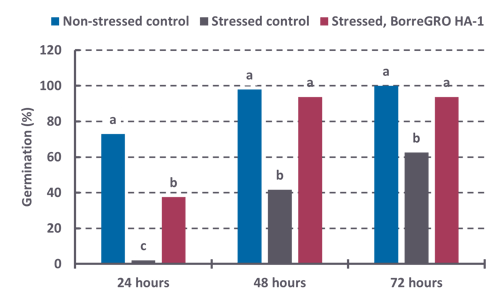
Drought stress trial

In controlled studies simulating drought conditions, BorreGRO HA-1 significantly improved wheat seed germination, demonstrating stronger early-stage resilience under water stress.

Trial data

Mitigating salinity stress


Our solutions improve soil structure and soil ion balance, helping reduce sodium-related stress while supporting root development, water movement and nutrient availability under saline conditions.

  • Improve soil structure and water infiltration
  • Increase calcium availability, lowering SAR
  • Reduce sodium-induced stress

ROOT_HA1

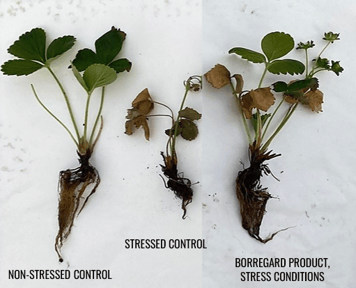
Pot trials demonstrated that BorreGRO® HA-1 significantly improved strawberry growth under salinity stress. By improving soil conditions and reducing sodium-related stress, it supported stronger root development and overall plant growth compared to untreated stressed plants. 

  • +162% aerial biomass

  • +54% root length


Trial data

Improving soil aggregate stability

Healthy soil forms small, stable clumps with pore spaces between them. Those pores are what let water soak in, air reach the roots and roots push down. When soil loses this structure, it crusts over and erodes, water runs off instead of soaking in, and roots struggle.

Borregaard's bio-based solution made soil clumps significantly more resistant to breaking apart in water. Our products hold the structure together, so it survives rain and irrigation instead of collapsing into mud and dust. 
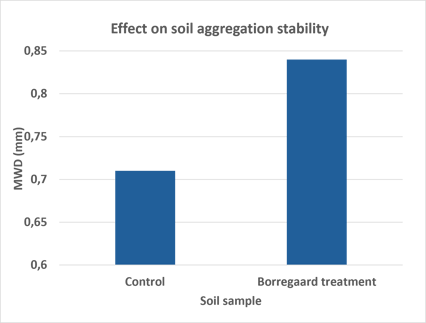
soil aggregation

+18% more stable soil structure (MWD 0.71 → 0.84 at 0.02 g/kg)

Frequently asked questions

  • What is abiotic stress, and why does it matter?

    Abiotic stress covers non-living pressures that hold crops back, including drought, salinity and poor soil structure. They limit how much water and nutrient a plant can take up, slow growth and can cut yields sharply. With climate variability rising, these conditions are hitting more fields, more often.

  • How can Borregaard help crops in high-salinity soils?

    Sodium in the soil blocks water and nutrient uptake and breaks down soil structure. Borregaard's solutions release that sodium so it can be flushed away and replaced by calcium or other nutrients, letting water move freely through the soil again. At the same time, their biostimulant action helps the plant keep taking up water and nutrients even while salt is still present. 

  • Can I use this alongside gypsum or other calcium correctors?

    Yes, they work better together. Correctors like gypsum, calcium thiosulfate or acidifiers supply calcium, but that calcium can only replace sodium once the sodium is released from the soil. Borregaard's solutions mobilise the sodium locked in the soil so the calcium can move in and take its place, making the corrector more effective, not redundant. On top of that, they add a biostimulant, anti-stress effect that purely chemical correctors don't have, keeping the plant productive while the soil recovers.

  • My soil already has high calcium from years of gypsum, is this still useful?

    Yes. Borregaard's solutions come in calcium, ammonium and potassium forms. Where calcium is already in excess, the ammonium or potassium form mobilises sodium and delivers the same biostimulant benefit without adding more calcium, helping rebalance the soil instead of loading it further. 

  • Do I need to flush the soil with irrigation for it to work?

    Irrigation helps carry the released sodium below the root zone, so it's useful. But growers often see improvement even before full flushing, because the biostimulant effect supports the crop directly. Water speeds the process up; it isn't the only lever.

  • Why is soil structure important for stress tolerance?

    Well-structured soil forms stable clumps with pores that let water soak in, air reach the roots and roots grow deep. Borregaard's solutions help build and maintain that structure. Divalent cations such as calcium act as bridges between soil particles and the clay-humus complex. Better structure means more stored water and more resilience when conditions turn dry or saline.

  • Can these solutions be built into existing fertiliser formulations?

    Yes. They're highly soluble and stable across a wide pH range, including high-salt fertiliser blends, and come in soluble powder or liquid form, so manufacturers can add them to a broad range of soil and foliar products without reformulating.

  • Are these solutions compatible with irrigation systems and organic farming?

    Yes. Selected Borregaard products are OMRI Listed and are compatible with standard irrigation systems. As organic certification schemes vary by region, confirm the specific approval that applies to your market.

Find the right solution for abiotic stress, drought and salinity

Contact our team to discuss your formulation requirements and receive technical support, trial data, or product samples.