CROP PROTECTION CO-FORMULANTS

Improved storage stability of suspension concentrates 

Water-based suspension concentrates (SCs) have become a preferred formulation in modern crop protection: dust-free, free of hazardous solvents and easy to handle. As adoption grows, formulators increasingly use suspension concentrates for active ingredients with intermediate to high water solubility, not only for traditionally low-solubility actives. That widens the stability challenge: the more soluble the active, the more prone the SC is to crystal growth and particle-size changes during storage. Borregaard's lignin biopolymers adsorb onto the active particles to keep particle size and rheology stable from production to application. 

KEY CHALLENGES:

  • Ostwald ripening and agglomeration increase particle size over time, compromising formulation stability
  • Rheology changes during storage affect pourability
  • Sedimentation can lead to caking and difficulty with re-dispersing

How we make formulations more stable

Borregaard's lignin biopolymers and lignosulfonates adsorb onto active ingredient particles and create a protective layer that stabilises formulations through electrostatic repulsion, steric hindrance and crystal growth inhibition.

Electrostatic repulsion

The adsorbed lignosulfonate layer carries a negative charge, causing particles to repel each other and preventing them from agglomerating.

Steric hindrance

Due to lignosulfonates being large molecules, they can create a physical barrier that keeps particles apart even when electrostatic repulsion is reduced in hard water or high-salt conditions.

Crystal growth inhibition

Lignosulfonates control Ostwald ripening by adsorbing onto the active growth sites of crystals, thereby reducing formation of larger particles. 

Consistent rheology

By keeping particles stable and well-dispersed, lignosulfonates maintain consistent rheology, improving formulation stability throughout the product's shelf life.

our solutions

Proven bio-based biopolymers for sc stabilisation


Borregaard offers several products for SC formulations. Each solution brings a distinct performance profile, giving formulators the flexibility to select the right one for their specific active ingredient, formulation conditions and stability requirements. 

Vanisperse CB

A highly modified lignosulfonate effective at inhibiting crystal growth in suspension concentrates. Vanisperse® CB adsorbs strongly onto active ingredient surfaces and prevents crystal growth via electrostatic repulsion. It is particularly suited for active ingredients with high solubility and/or low melting point. 

Ufoxane 3A

Ufoxane® 3A is a modified lignosulfonate which stabilises SCs primarily through steric hindrance and is especially suited for formulating hydrophobic active ingredients. 

Ultrazine NA

A purified lignosulfonate with higher salt tolerance than Vanisperse CB and Ufoxane 3A. 

Ultrazine® NA can be used alone or in combination with different dispersant chemistries. 

Trial data

What the performance shows


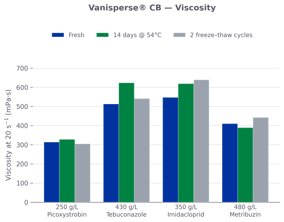
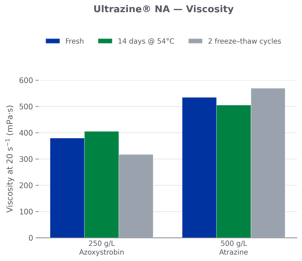
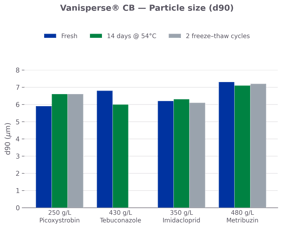
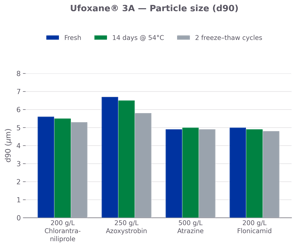
Formulations of different active ingredients were prepared using Borregaard products and storage stability was evaluated under accelerated heat storage (14 days at 54°C) followed by freeze–thaw cycling (at -18ºC/+20ºC). 

Vanisperse® CB was evaluated across four actives: a low-melting-point active (Picoxystrobin) and higher-solubility actives prone to Ostwald ripening (Tebuconazole, Imidacloprid, Metribuzin). Vanisperse CB suppressed crystal growth and maintained rheology across all conditions. 
sc_vanisperse_cb_d90sc_vanisperse_cb_viscosity


Ufoxane® 3A was tested across low- to intermediate-solubility actives (Chlorantraniliprole, Azoxystrobin, Atrazine) and a highly soluble active (Flonicamid). Ufoxane 3A stabilises the suspension through a combination of steric hindrance and electrostatic repulsion.
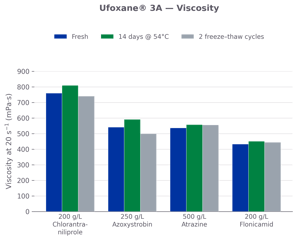
sc_ufoxane_3a_d90  sc_ufoxane_3a_viscosity

Ultrazine® NA was tested with Azoxystrobin and Atrazine (low to intermediate-solubility actives). The product controlled particle growth and maintained consistent rheology. 
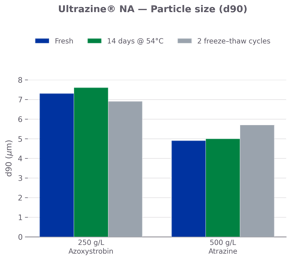
sc_ultrazine_na_d90  sc_ultrazine_na_viscosity


Learn more with our experts

Do you want to understand the full science behind electrolyte-tolerant SC formulations? Watch our on-demand webinar with Borregaard's formulation specialists.

CO-FORMULANT SOLUTIONS FOR HIGH ELECTROLYTE CROP PROTECTION FORMULAS
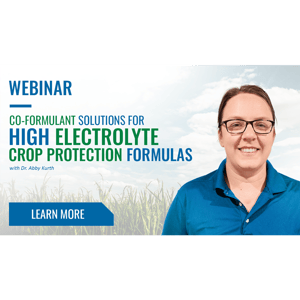
Co-formulant solutions for high electrolyte crop protection formulations

Join Dr. Abby Kurth for a 30-minute webinar on formulating in high-electrolyte crop protection systems, where high salt concentrations destabilise suspensions and cause common thickeners and dispersants to fail. Learn how sustainable, bio-based co-formulants maintain rheology, suspension stability and dispersancy under high ionic strength. The presentation is followed by a Q&A.

Here is what you can expect:

  • Tuning rheology in high-salt systems with cellulose fibrils, where common gums fail
  • Salt-tolerant dispersants: modified lignosulfonates designed for high electrolyte formulations
  • Increasing foliar residence time and rainfastness through temporary cellulose films
  • Strong regulatory and sustainability status, including approval for organic farming

Watch now!

Frequently asked questions

  • What causes physical instability in SC formulations and how can bio-based ingredients prevent it?

    The main causes are crystal growth — through Ostwald ripening and agglomeration — viscosity changes on storage and sedimentation. Borregaard's bio-based biopolymers adsorb onto the surface of active ingredient particles, preventing agglomeration through electrostatic repulsion and steric stabilisation. This keeps the particle size distribution stable over time, ensuring that SCs retain flow and maintain pourability.

  • Are Borregaard’s SC dispersants backed by sustainability credentials as well as performance data?

    Yes. Borregaard's dispersants for SC formulations are bio-based, derived from wood lignin, and carry independently verified EPDs and life cycle assessment data. Some of our products are also OMRI listed.

  • How can I request a sample?

    Contact our technical team through the form below to discuss your formulation requirements and request a sample.

Ready to improve your sc formulation?

Talk to our technical team or request performance data for your specific active ingredient.