.png?width=517&height=128&name=Group%20(2).png "Group (2)")
CROP PROTECTION CO-FORMULANTS
Prevent precipitation in soluble liquids
Soluble liquid (SL) formulations are widely used in crop protection due to their high active ingredient loading and ease of application. However, crystallisation during storage or on dilution in hard water remains a key stability challenge. Borregaard's biopolymers keep active ingredients dissolved and sprayable throughout storage and in the field.
KEY CHALLENGES:
- Low-temperature storage pushes high-load SLs past their solubility limit, causing crystallisation.
- Divalent ions in hard water cause the active ingredient to precipitate on dilution, thereby causing clogging of filter nozzles.
- High active loading leaves a narrow margin between full solubility and crystallisation.
Biopolymers that keep active ingredients dissolved
Borregaard's lignin-based biopolymers maintain in-can SL stability by preventing crystal growth. Additionally, on dilution of SL in hard water, the biopolymer interacts with the divalent cations to prevent precipitation.
Low-temperature storage stability
Biopolymers keep the active ingredient dissolved down to -5°C, preventing the crystallisation that high-load SLs are prone to during cold storage and transport.
Robustness in hard water
On dilution, our lignin-based biopolymers inhibit interactions between active ingredients and dissolved mineral ions, helping prevent the rapid precipitation triggered by hard water.
Effective at low inclusion levels
Only a small amount of biopolymer is needed in the formulation, making this a cost-efficient solution that can be implemented with minimal effort.
Performance in real-world formulations
A demanding formulation, containing 780 g/L 2,4-D DMA at pH 5.6, was tested under two critical stress conditions: one-month storage at 0°C versus room temperature, and dilution in 350 ppm hard water.
Test 1: Low-temperature storage stability
Without a lignosulfonate, the SL precipitates at both room temperature and 0°C. With just 0.5% Ultrazine® NA or Vanisperse® CB added, the formulation stays homogeneous and precipitate-free after one month at 0°C.
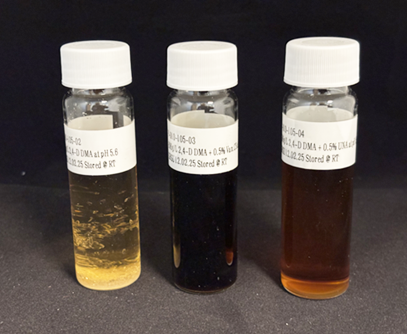 After 1 month at room temperature (20-22ºC)
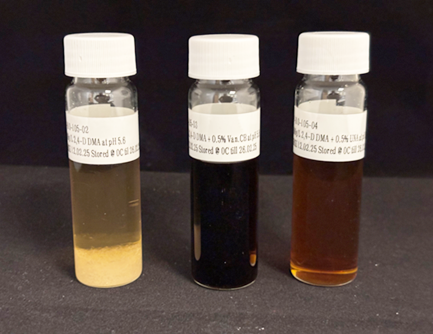 After 1 month at 0ºC
Test 2: HARD WATER DILUTION
On dilution in 350 ppm hard water, the SL containing the biopolymer shows no crystallisation, while the reference formulation precipitates.
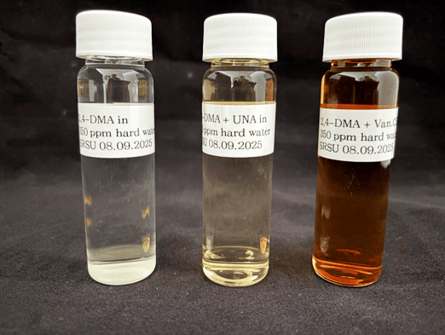
Key takeaway
Even high active-loading formulations near their solubility limit can be stabilised with small additions of Borregaard's lignosulfonates, helping address both cold-storage and hard-water challenges.
OUR SOLUTIONS
Bio-based solutions for SL formulation stability
our solutions
Bio-based solutions for SL formulation stability
Two complementary lignin-based products, both effective at low inclusion levels and backed by independently verified sustainability data.
Frequently asked questions
-
Why do high active-loading SL formulations precipitate at low temperatures?
A soluble liquid is a true solution, in which the active stays dissolved. High-load SLs are formulated close to their solubility limit, and low-temperature storage and temperature fluctuations lower solubility enough to push the active past it, therefore, triggering crystallisation and precipitation. Borregaard's lignosulfonates inhibit crystal growth and keep the active dissolved down to 0°C, as shown in the 780 g/L 2,4-D DMA trial.
-
Will biopolymers also prevent precipitation when the SL is diluted in hard water?
Yes. On dilution, the dissolved active can interact with the divalent ions (Ca²⁺, Mg²⁺) present in hard water and precipitate out. A small addition of lignosulfonate inhibits this interaction, keeping the spray solution homogeneous and preventing the formation of crystals that can block nozzles. In trials, an SL containing biopolymer showed no crystallisation on dilution in 350 ppm hard water.
-
How can I request a sample?
You can contact our team via the form below.